

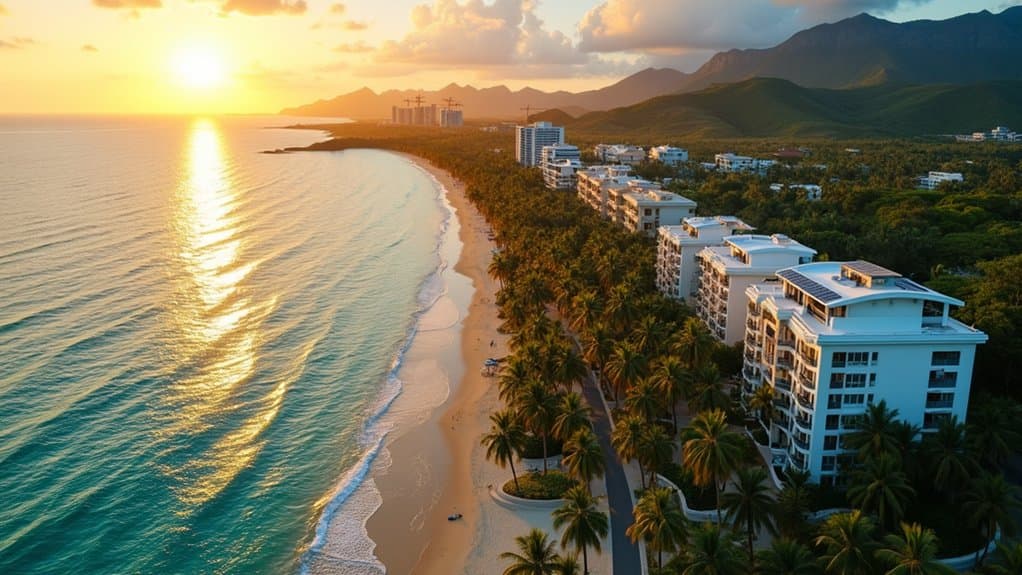
I was sitting in my Sosúa office last Tuesday morning, reviewing a title for a Canadian couple who'd found their "dream condo" on a popular listing site. The property looked perfect online—ocean views, modern finishes, listed at $185,000. They'd already wired a $5,000 deposit when they finally thought to check the title. The Deslinde wasn't just incomplete; it didn't exist. The seller had been marketing a property he couldn't legally transfer. We got the deposit back, but it took three months and a lawyer's letter that made the developer nervous.
That same afternoon, I drove through Cabarete's main corridor. Within two kilometers, I counted five active construction sites—cranes visible from the road, foundations poured, vertical walls rising. The parking lots at these developments weren't empty. I noted license plates from Ontario, New York, Florida. Not tourists. Long-term money.
This is the Dominican Republic real estate market in early 2026: genuine opportunity layered with operational complexity. The data shows $4.39 billion in foreign direct investment flowing into the country in 2023, a 7.1% increase year-over-year. Tourism reached approximately 10.3 million visitors in 2024—a solid number, though not the 11-12 million some overly optimistic projections claimed. The economy grew 5.1% while the rest of Latin America averaged 2.2%. These aren't vacation numbers. This is capital seeking yield in a USD-denominated market with structural advantages most investors don't understand yet.
But the spreadsheets don't mention the blackouts. They don't explain why a property with a clean Deslinde sells in 45 days while one without sits for eight months. They certainly don't warn you about the gap between asking prices and what actually closes.
Key Takeaways
Legal Reality: Law 108-05, enacted in March 2005 (though its full implementation and regulations rolled out over subsequent years, particularly in 2007), mandates GPS-verified property boundaries (Deslinde). Without this, you cannot secure financing, clear title transfer, or avoid boundary disputes—yet roughly 30% of listings lack it.
Price vs. Reality: While online platforms show asking prices up 10-12% in 2024, actual closing prices for properties over $500,000 typically settle 8-12% below list. The negotiation window is wider than sellers admit.
Infrastructure Hedge: Electricity grid instability remains the single largest operational risk. Properties with solar systems (ROI now under 3.5 years) and Starlink command 15% higher occupancy because digital nomads require uptime, not excuses.
Residency Path: The Pensionado visa requires only $1,500 USD monthly guaranteed income—significantly lower than Portugal's D7 (which requires income equivalent to the Portuguese minimum wage, currently around €870/month or approximately €10,440/year as of 2025) or Panama's Friendly Nations threshold. Foreign pensions are taxed at 0%.
Yield Expectations: Realistic net rental yields range 5-7% for long-term tenants, 8-12% gross for short-term vacation rentals in prime Cabarete locations with 85%+ high-season occupancy.
The Inventory Mirage
There are approximately 750 active "for sale" listings between Sosúa and Cabarete right now. Sounds like plenty of choice. It's not.
Roughly 30% of that inventory is what I call "stale stock"—older construction from the 2008-2012 era, often with title complications or deferred maintenance that will cost you $50,000+ to remedy. Another 25% is priced 20% above comparable sales because sellers read the same optimistic market reports you're reading and decided their property is special. It's not.
About 15% is raw land, which is a different conversation entirely—long-term hold, requires local partnerships, involves zoning negotiations that can take years.
That leaves roughly 30% of listings that are genuinely investable: turnkey or near-turnkey properties with clean titles, modern infrastructure, and realistic pricing. These units—the "A-Class" inventory—sell fast. Average days on market is under 60 days for well-priced condos in Cabarete's beachfront zone.
Meanwhile, there are 1,580 active short-term rental listings on Airbnb and VRBO in the same area. The discrepancy tells you something important: people who own quality properties here aren't selling. They're renting them and collecting 8-12% gross yields while the asset appreciates 4-6% annually in a USD-denominated market.
What Actually Closed Last Quarter
Listing prices went up 10-12% in 2024. Sellers got confident. Perhaps too confident.
In the last seven transactions my firm handled for properties over $500,000, the average closing price was 9.3% below the original asking price. One seller started at $625,000 and closed at $545,000 after the property sat for 147 days. Another started at $380,000, dropped to $350,000 after three months, and finally accepted $332,000 when the buyer showed up with cash and a 45-day close.
The pattern is consistent: properties priced aggressively sit. Properties priced at or slightly below recent comps move quickly, often with multiple offers. Cash buyers—who represent about 65% of foreign transactions here—have leverage. They know financing takes 60-90 days and costs 8.25-9.00% for non-residents. A seller facing a financed offer at full price versus a cash offer at 7% below asking will usually take the cash.
The per-square-meter data shows similar compression. Sosúa gated communities list at $2,200-$2,600/m², but actual sales are closing closer to $2,000-$2,300/m². Cabarete beachfront condos list at $2,800-$3,500/m² but close at $2,500-$3,100/m².
This isn't a collapse. It's a correction. Sellers who bought in 2019-2021 are still seeing 30-40% appreciation from their entry point. They're just not getting the windfall they thought they'd get six months ago.
The Infrastructure Question Nobody Wants to Answer
Edenorte, the northern electricity distributor, executed 418,000 technical interventions in 2024. That's not a typo. Four hundred eighteen thousand repairs, upgrades, and responses to grid failures in a single year.
The grid is unstable. It's improving—slowly—but it's unstable. Approximately 18-21% of the country's renewable energy capacity is currently curtailed (wasted) because the infrastructure can't handle the input. This isn't a political problem or a corruption problem. It's an engineering problem that requires billions in capital and years to fix.
For property investors, this creates a clear dividing line: properties with energy autonomy versus properties dependent on the grid.
A $15,000 solar installation with battery backup now delivers ROI in 3.5 to 4 years due to rising electricity tariffs (18-22 cents per kWh). More importantly, it creates an "occupancy premium." Short-term rental guests—especially digital nomads working remotely—will pay 10-15% more per night for a property that guarantees power. They'll also leave better reviews, which compounds your occupancy advantage on platforms like Airbnb.
Starlink has solved the internet problem. For RD$2,900/month (roughly $50 USD), you get reliable, high-speed connectivity that doesn't depend on local cable infrastructure. Every serious rental property in Cabarete now has it. It's not optional.
The combination of solar + Starlink transforms a liability (unreliable utilities) into a competitive moat. Your property becomes the one that works when others don't.
The Title Trap
Law 108-05, enacted in March 2005, requires all property boundaries to be GPS-surveyed and registered in the national land registry system. This process creates what's called a "Deslinde"—a certified title with precise coordinates that eliminates boundary disputes.
Before this law, many properties were sold using "constancias," which are essentially shares of a larger parcel. You might own "1/8th of Parcel 47," but nobody knew exactly where your boundaries were. Disputes were common. Financing was impossible.
The law was good. The implementation has been slow.
Approximately 30% of properties currently listed for sale in Sosúa and Cabarete do not have a finalized Deslinde. Some are in process. Some haven't started. Some sellers don't even realize it's missing until a buyer's lawyer (hopefully) catches it during due diligence.
Here's what happens if you buy without a Deslinde:
You cannot get a mortgage from a Dominican bank. They won't lend against an uncertified title.
You cannot sell the property later without completing the Deslinde process yourself, which can take 6-18 months and cost $3,000-$8,000 depending on complications.
You risk boundary disputes with neighbors, especially if the property borders public land, beach access, or older parcels with unclear demarcation.
The fix is simple: verify the Deslinde before you wire the deposit. A competent real estate attorney can pull the title records from the Puerto Plata land office in 48 hours. If the Deslinde is missing, you have three options: walk away, negotiate a price reduction to cover the cost and delay of completing it yourself, or require the seller to complete it before closing.
Most sellers will agree to option two or three if you're serious. The ones who refuse are usually hiding something.
The CONFOTUR Advantage Nobody Explains Properly
The CONFOTUR law (Tourism Incentive Law) offers tax exemptions for properties in designated tourism zones. If you buy a qualifying property, you avoid:
The 3% property transfer tax (normally paid at closing).
The 1% annual property tax (IPI) for 10-15 years depending on the project classification.
On a $300,000 property, that's $9,000 saved at closing and roughly $3,000/year saved in ongoing taxes. Over 15 years, you're looking at $54,000 in total tax savings.
The catch: only newly approved developments qualify. You can't buy a resale condo built in 2015 and claim CONFOTUR benefits. The developer must have applied for and received CONFOTUR status before construction, and the benefits transfer to the first buyer only.
This creates a strategic opportunity for buyers willing to purchase pre-construction or newly completed units in CONFOTUR-approved projects. Your effective cost basis is 3-4% lower than a comparable resale property, which improves your yield immediately.
The Ministry of Tourism maintains a list of approved CONFOTUR projects. Verify before you commit. I've seen developers claim CONFOTUR status that was either pending or denied. If it's not on the official list, you're not getting the exemption.
The Residency Calculation
The Pensionado visa requires $1,500 USD per month in guaranteed income from a pension, Social Security, or annuity. Add $250/month for each dependent. That's it.
Compare that to Portugal's D7 visa, which requires proof of income equivalent to the Portuguese minimum wage—currently around €870/month (approximately €10,440/year as of 2025)—or Panama's Friendly Nations program, which requires a $5,000 deposit in a Panamanian bank plus proof of economic ties.
The DR's threshold is lower. Significantly lower.
Foreign pensions are taxed at 0% under Law 171-07. You're not giving up 10% to the Portuguese tax authority or navigating the new NHR restrictions. Your Social Security check or Canadian pension arrives in your Dominican bank account untouched.
The process takes 6-12 months if handled correctly. You'll need:
Apostilled birth certificate and police clearance from your home country.
Proof of pension income (official letter from the pension provider).
Health certificate from a Dominican doctor.
Proof of address in the DR (lease or property deed).
The filing fee is roughly $1,000-$1,500 depending on whether you're applying as a couple or individual. Legal fees for a competent immigration attorney run $2,000-$3,500 total.
Once approved, you're a legal resident. You can stay indefinitely. You can work (though most retirees don't). You can import a vehicle duty-free. And critically, you can open local bank accounts, which makes managing your rental property significantly easier.
What the Comparables Actually Show
| Metric | Dominican Republic (North Coast) | Dubai (UAE) | Portugal (Lisbon) | Panama (City) |
|---|---|---|---|---|
| Entry Price (Prime Location) | $180,000 - $250,000 | $450,000+ | $500,000+ | $275,000+ |
| Gross Rental Yield | 8-12% (Short-term) | 6-7% | 5-6% | 5-7% |
| Residency Income Requirement | $1,500/month | Investment only (no income path) | ~€870/month (~€10,440/year as of 2025) | $1,000/month |
| Foreign Pension Tax | 0% | 0% | 10% (under new NHR rules) | 0% |
| Currency | USD-denominated market | AED (pegged to USD) | EUR (volatile vs. USD) | USD |
The DR wins on entry price and residency accessibility. You can buy two quality condos in Cabarete for the price of one in Lisbon. The yield advantage is measurable—8-12% gross in high season versus 5-6% in Portugal. And you're not navigating EUR/USD exchange risk.
Dubai offers similar tax advantages but requires significantly more capital. Panama is closer in price but lacks the tourism infrastructure and beach culture that drives rental demand.
The North Coast isn't competing with these markets on prestige. It's competing on yield, accessibility, and the lifestyle-to-cost ratio.
The Financing Reality
Dominican banks will finance up to 70% of appraised value for foreign buyers. Rates are currently 8.25-9.00% USD fixed for 1-5 years. Scotiabank and Banco Popular are the primary lenders.
At 8.5% interest, your financing cost is eating roughly half your rental yield. A property generating 7% net yield only delivers 3-3.5% return after debt service. That's not attractive.
This is why 65% of foreign transactions close with cash. The math favors it.
But cash buyers also have negotiating leverage. A seller facing a financed offer knows the buyer needs 60-90 days for bank approval, appraisal, and underwriting. A cash buyer can close in 30 days. That speed is worth 5-10% to a motivated seller.
If you're financing, focus exclusively on high-yield, turnkey properties where the rental income covers the mortgage payment plus operating costs. Anything else becomes a cash-flow drain.
The 2026 Forecast
Cabarete beachfront properties are projected to appreciate 4-6% in 2025-2026 due to land scarcity. The coastline is finite. The number of buildable oceanfront lots is shrinking. Developers are moving inland or building vertically.
Long-term rental yields will likely hold at 5-7% net. Short-term vacation rental yields in prime locations (Kite Beach, Encuentro Beach) should maintain 8-12% gross, assuming you maintain competitive infrastructure (solar, Starlink, modern finishes).
Inflation in the DR was 3.35% year-over-year as of December 2024—one of the lowest rates in Latin America. The Central Bank has maintained relative stability. Your USD-denominated asset is appreciating in a low-inflation environment, which is rare.
The risk factors:
Grid instability remains unresolved. Budget for solar if you're buying anything built before 2020.
Title issues persist. Never skip the Deslinde verification.
Inventory quality is uneven. The "A-Class" supply is tight, which supports pricing, but also means you can't afford to overpay for a mediocre property.
Political risk is low but not zero. The current administration is pro-tourism and pro-investment, but elections happen. Diversify if you're deploying significant capital.
What Cash Buyers Should Do Right Now
Target the "stale" inventory—properties listed over 180 days. These sellers are tired. They're often willing to negotiate 12-18% below original asking price, especially if you can close quickly.
Look for properties needing cosmetic renovation rather than structural work. A $25,000 investment in new appliances, paint, and modern fixtures can increase rental income by 20-30% and occupancy by 10-15%.
Verify the Deslinde before making an offer. If it's missing, negotiate a price reduction equal to the cost and delay of completing it yourself (typically $5,000-$8,000).
Prioritize properties with existing solar installations or space to add them. The autonomy premium is real and growing.
What Financed Buyers Should Avoid
Don't finance a property that requires significant renovation. Your debt service plus renovation costs will kill your cash flow for 12-24 months.
Don't buy in developments with high HOA fees (over $200/month) unless the amenities justify premium rental rates. High fees compress your net yield.
Don't assume appreciation will bail you out. Buy for cash flow first. Appreciation is a bonus, not the strategy.
What Sellers Should Know
If you own an "A-Class" property—clean title, modern infrastructure, prime location—hold through 2026. The inventory crunch for quality units will likely support 4-6% price appreciation.
If you own a property that needs work or has title complications, price it aggressively now. The longer it sits, the more negotiating power buyers gain.
If you're selling to finance another purchase, consider the opportunity cost. Rental yields here are 5-7% net. Can you redeploy that capital elsewhere and beat that return after taxes and transaction costs?
Summary: Investor Due Diligence Checklist
Before wiring a deposit on any Dominican Republic property, verify the following:
[ ] Legal: Confirm the property has a finalized Deslinde (Law 108-05 GPS-verified title, enacted in 2005). Request a copy from the seller and verify it against Puerto Plata land office records. Properties without this cannot be financed or cleanly transferred.
[ ] Financial: Calculate the all-in cost including the 3% transfer tax (unless CONFOTUR-exempt), 1% legal fees, and 1% miscellaneous closing costs. Budget 5% of purchase price for total closing costs.
[ ] Infrastructure: Inspect the electrical system and internet connectivity. Properties dependent on the grid without solar backup will face occupancy challenges. Starlink is now standard for serious rental properties.
[ ] Tax Status: Verify CONFOTUR status if the developer claims tax exemptions. Check the official Ministry of Tourism approved projects list. Exemptions apply only to first buyers in newly approved developments.
[ ] Residency: If planning to use the Pensionado visa, confirm your pension or Social Security income meets the $1,500/month threshold and obtain an official income verification letter before starting the application.
[ ] Rental Potential: Review actual occupancy data for comparable properties on AirDNA or VRBO. Don't rely on developer projections. Realistic gross yields for short-term rentals in prime Cabarete locations range 8-12%; long-term yields are 5-7% net.
[ ] Title Insurance: Consider purchasing title insurance if available. While not standard in the DR, some international underwriters now offer policies for properties with verified Deslindes.
[ ] Currency Risk: Understand that while properties are priced in USD, operating costs (electricity, property management, HOA fees) are paid in Dominican pesos. Budget for minor currency fluctuation, though the peso has remained relatively stable (3.35% inflation in 2024).
The Final Word
Real estate in the Dominican Republic isn't a get-rich-quick scheme. It's a calculated investment in a USD-denominated market with structural yield advantages, provided you navigate the operational complexity.
The couple who almost bought the property without a Deslinde? They eventually found a turnkey condo in a CONFOTUR-approved development near Encuentro Beach. Clean title. Solar installation. Starlink. They paid $220,000, avoided the 3% transfer tax, and are currently generating 9.2% gross yield through short-term rentals managed by a local property management company.
They got there by doing the work the first seller hoped they'd skip: verifying the title, understanding the tax structure, and budgeting for the infrastructure that makes a property rentable versus just livable.
The market is offering genuine opportunity in early 2026. The $4.39 billion in foreign direct investment and 10.3 million annual visitors in 2024 aren't hype. But the opportunity exists within a framework of local complexity that rewards diligence and punishes assumptions.
Verify first. Trust later. And never, ever wire a deposit before a qualified attorney reviews the title.
If you're serious about evaluating specific properties on the North Coast, my firm maintains direct contacts at the Puerto Plata land office and can verify title status within 48 hours. The $1,500 legal verification fee is the cheapest insurance you'll ever buy.