

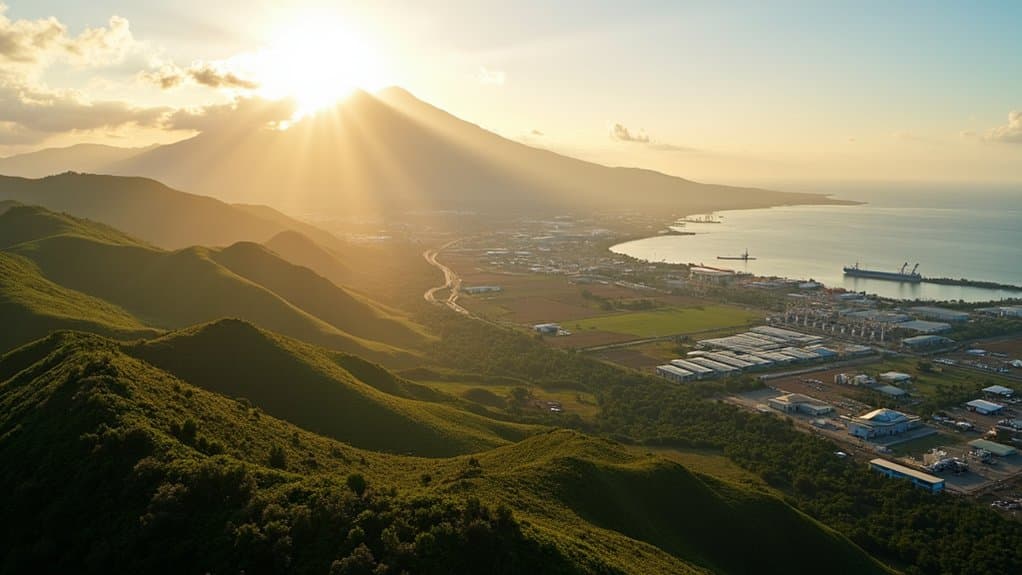
You are probably searching for homes for sale in Puerto Plata because someone showed you a PDF with beautiful renderings and a number that ended in "% annual return." Maybe it was 10%. Maybe it was 12%. The number does not matter because it is probably wrong.
Not wrong in the sense that they are lying—though some are—but wrong in the sense that they are showing you the revenue line at the top of the spreadsheet and pretending the expense lines below it do not exist. I have been reviewing real estate contracts in this province since 1986, and the single most common mistake I see is investors who confuse gross rental income with the cash that actually shows up in their bank account after the property manager takes their cut, after Edenorte bills them $200 for running the air conditioner in August, and after they replace the water pump that corroded from salt air.
If you are serious about Puerto Plata villas for sale or condos for sale in Puerto Plata, you need to understand Net Operating Income. Not because it sounds impressive at a cocktail party, but because it is the only number that tells you whether you are building wealth or subsidizing someone else's vacation.
Key Takeaways
- Real Returns: Actual net rental yields in Puerto Plata range from 5.9% to 7.5% after all expenses—not the 10-12% gross figures in marketing materials
- CONFOTUR Advantage: Law 158-01 eliminates the 3% transfer tax and 1% annual property tax for 15 years, transferable to future buyers
- Title Verification: Law 108-05 requires a Deslinde (GPS boundary certificate) for legal transfer—never close without one
- Hidden Costs: Budget 4.5-5.5% of purchase price for closing costs, plus 1.5% annually for tropical maintenance reserves
- Airport Impact: VINCI's $830M investment in Gregorio Luperón International Airport through 2060 is the primary infrastructure driver for North Coast appreciation
The Case Study: Unit 402 (The One Nobody Wants to Show You)
Let me show you a real transaction we closed in Q3 2024. Two-bedroom condo in a gated community fifteen minutes from Gregorio Luperón International Airport. Ocean view. Pool. Security. The listing promised "turnkey investment opportunity with strong rental history."
Purchase Price: $350,000
Closing Costs (5%): $17,500
Furniture Package: $25,000
Total Cash Invested: $392,500
That last line is important. You cannot rent an empty concrete box. The $25,000 for furniture is not optional if you want to compete on Airbnb. Marketing materials love to calculate returns based on the purchase price alone, but your money is tied up in the full $392,500, not just the $350,000 you paid the seller.
The listing advertised gross rental income of $60,000 annually. That number was technically accurate—if you rented the unit 365 days a year at peak season rates and never spent a dollar on anything. Here is what actually happened:
Gross Revenue (Realistic Occupancy): $52,000
Property Management (25%): -$13,000
Electricity (A/C 6 months): -$1,800
HOA Fees: -$3,600
Internet (Starlink): -$600
Insurance: -$1,400
Maintenance Reserve (1.5%): -$5,250
Property Tax (IPI): -$1,800
Net Operating Income: $24,550
That is a 6.26% return on the actual cash invested. Not 12%. Not even 8%. Just over 6%.
Is that bad? Not necessarily. A 6% return in USD on a hard asset in a growing market beats the 4% you might get from a bond, and it does not account for appreciation. But it is honest. And honesty is the only way to make a decision you will not regret three years from now when the water heater explodes and you realize your "passive income" requires you to wire money to the Dominican Republic every other month.
Where the Money Actually Goes (The Bleed)
Property management takes 25% if you are using a reputable firm. You will see listings that claim "only 15%," but those are usually long-term rental rates or firms that do not answer the phone when the guest locks themselves out at 2 AM. Short-term vacation rentals require someone to coordinate cleaning, handle check-ins, manage maintenance calls, and deal with the guest who complains that the beach has waves. That service costs 20-25% of gross revenue. If you think you can manage it yourself from Toronto or Munich, you are wrong. I have watched people try. It does not work.
Electricity is the silent killer. Edenorte charges tiered rates, and if you are running air conditioning for guests who leave it on 24/7, you are paying over $0.30 per kilowatt-hour in the higher consumption brackets—particularly once you exceed 700 kWh monthly, which pushes you into the BTS-2 tariff level. A 1,800 square foot condo with central air can easily hit $200-$250 per month during high season. That is $2,400 annually, not the $600 the developer mentioned in passing during the sales pitch.
HOA fees in beachfront communities average $150 to $400 monthly depending on amenities. Ocean Village charges around $2.50 per square meter per month. For a 100-square-meter unit, that is $250 monthly or $3,000 annually. This covers pool maintenance, security, common area insurance, and sometimes water. It is non-negotiable and it increases every few years.
Internet matters more than you think. Starlink changed the game for remote workers, but it costs RD$2,900 monthly (about $50 USD). Fiber optic from Claro or Altice runs $30-$50 for decent speeds. If your listing advertises "perfect for digital nomads," you need reliable internet, and that is another $600 annually minimum.
Insurance for a coastal property with hurricane coverage typically runs 1% to 1.5% of the replacement value of the structure. Not the land—the building. For a $350,000 condo where the land represents maybe $100,000 of that value, you are insuring $250,000 of structure. That is $2,500 to $3,750 annually. I used $1,400 in the example above because it was an older building with lower replacement costs, but newer construction will be higher.
The maintenance reserve is what separates amateurs from professionals. Salt air corrodes everything. Humidity warps wood. UV destroys finishes. You need to budget 1.5% of the property value annually for repairs that are not covered by insurance. Air conditioning units fail. Water heaters leak. Tiles crack. If you do not set aside money for this, you will fund it out of pocket when it happens, and it always happens.
Property tax—the IPI—is 1% annually on the value exceeding RD$10,190,833 (approximately $172,000 USD as of 2025). For a $350,000 property, you are paying 1% on roughly $178,000, which is $1,780 annually. Unless the property has CONFOTUR status, in which case you pay nothing for fifteen years. We will get to that.
The Three Seasons (Or Why 100% Occupancy Is a Fantasy)
High season runs December through March. This is when Canadians flee the snow and Americans book their winter escapes. During these four months, you can achieve 80-90% occupancy at premium rates. A two-bedroom condo might rent for $250-$350 per night. This is where you make 60% of your annual revenue.
Shoulder season is April through July. Occupancy drops to 50-60%. Rates drop to $150-$200 per night. You are still profitable, but barely. This is when you hope the air conditioner does not break because you do not have the margin to cover a $1,200 repair without eating into your returns.
Low season is August through October. Hurricane season. Schools are back in session. Americans are not traveling. Occupancy can drop to 30-40%, and in some years, you will have weeks with zero bookings. September and October are the months where you lose money. Your fixed costs—HOA, insurance, internet—do not stop, but revenue does. This is the reality that marketing brochures skip over.
When someone tells you their property generates 85% annual occupancy, they are either lying or they are pricing so low that they are leaving money on the table during high season. A realistic annual occupancy rate for a well-managed vacation rental in Puerto Plata is 60-70%. Anything above that is a bonus, not a plan.
The CONFOTUR Loophole (Why Some Properties Are Actually Worth It)
Law 158-01, the tourism incentive law, created CONFOTUR certification for approved tourism projects. If a property has CONFOTUR status, you avoid the 3% transfer tax at purchase, you pay zero annual property tax for fifteen years, and you are exempt from the 27% tax on rental income for the same period.
On a $350,000 purchase, that 3% transfer tax exemption saves you $10,500 immediately. The annual property tax exemption saves you $1,780 per year, or $26,700 over fifteen years. The rental income tax exemption is harder to quantify because it depends on your structure, but for a foreign investor, it can represent significant savings.
The critical detail: these benefits transfer to the next buyer. If you sell the property in year seven, the new owner inherits eight years of remaining tax exemptions. This makes CONFOTUR properties more liquid and easier to sell at a premium because the buyer is not just buying real estate—they are buying a tax advantage.
Not every new development qualifies. The project must have a specific CONFOTUR resolution number issued by the Ministry of Tourism. Developers love to use the word "CONFOTUR-eligible" in their marketing, which is meaningless. Either the project has the resolution or it does not. We verify this before any client signs a purchase agreement because I have seen too many buyers assume they are getting the tax benefits only to discover at closing that the developer never completed the application process.
| Tax/Fee | Standard Property | CONFOTUR Property | 15-Year Savings |
|---|---|---|---|
| Transfer Tax (3%) | $10,500 | $0 | $10,500 |
| Annual Property Tax (IPI) | $1,780/year | $0/year | $26,700 |
| Rental Income Tax | 27% | 0% | Varies by income |
| Total Direct Savings | — | — | $37,200+ |
The Title Problem (Law 108-05 and Why You Cannot Skip This)
The Dominican Republic uses the Torrens system, which means the government guarantees the title certificate is definitive proof of ownership. That sounds reassuring until you realize that older properties—anything sold before 2009—might not have a Deslinde, which is the GPS-verified boundary certificate required under Law 108-05.
A Deslinde is not just a survey. It is a judicial process involving court approval to confirm the exact GPS coordinates of the property boundaries. Without it, you cannot get a mortgage from a local bank, and technically, you cannot legally transfer the title. Some sellers will try to close with just a "Constancia Anotada," which is an older form of title documentation that is no longer sufficient.
We had a client in 2023 who was two days from closing on a villa in Costambar when we discovered the property had no Deslinde. The seller insisted it was not necessary because "everyone in the neighborhood knows where the boundaries are." That is not how property law works. We insisted on completing the Deslinde process before closing, which delayed the transaction by four months and cost the seller $2,800. The client was frustrated by the delay. Three months after closing, the neighbor tried to claim a portion of the driveway was on his land. Because we had the Deslinde, the dispute was resolved in one court hearing. Without it, the case could have dragged on for years.
The title search—the Certificación de Estado Jurídico—must be obtained from the Registro de Títulos to confirm the seller is the legal owner and to check for liens or mortgages. This is standard due diligence, but it is not automatic. You need a lawyer to request it, and the registry office can take anywhere from three days to three weeks to produce the document depending on how backed up they are.
We also verify the IPI status with the DGII because a property cannot be legally transferred if there are unpaid property taxes. I have seen deals fall apart at the last minute because the seller owed three years of back taxes and assumed the buyer would just "take care of it." That is not how it works. The seller pays the back taxes or the deal does not close.
The Bergantin Effect (Why Timing Matters)
The Punta Bergantin project is the single largest infrastructure investment in Puerto Plata Province in the last twenty years. The government is backing a tourism hub featuring 4,500 hotel rooms, 2,000 residential units, a film studio tied to Vin Diesel's One Race Films, and an innovation hub. The project is projected to create 20,000 jobs.
This is not speculative. Construction has started. Hyatt and Melia have signed agreements for branded hotels. The impact on surrounding real estate values is already visible. Raw land prices in the Montellano and Cangrejos areas—just east of the project site—have increased 15-20% year-over-year in 2024 alone.
The reason this matters for buyers looking at homes for sale in Puerto Plata is that appreciation is not evenly distributed. Properties within a fifteen-minute drive of Bergantin are seeing faster appreciation than properties in Sosua or Cabarete, which are already developed and saturated. If you are buying purely for capital appreciation rather than rental income, proximity to Bergantin is the variable that matters most.
But timing cuts both ways. Once Bergantin is fully operational and the 4,500 hotel rooms are online, the short-term rental market in Puerto Plata will face increased competition. Right now, the North Coast has limited hotel inventory compared to Punta Cana, which is why vacation rentals perform well. When Bergantin adds that capacity, some of the demand will shift to hotels, which means vacation rental owners will need to compete on price or amenities. This is not a reason to avoid investing—it is a reason to be strategic about what you buy and where.
The Airport Anchor (Why VINCI's $830M Commitment Changes the Math)
Gregorio Luperón International Airport is the reason Puerto Plata real estate is viable for foreign buyers. Without reliable airlift, nothing else matters. VINCI Airports recently extended their concession contract through 2060 and committed to an $830 million capital investment plan across their Dominican Republic airports, including POP.
Passenger traffic at POP grew 19% in 2024 compared to pre-pandemic levels. The airport now offers direct flights from Miami, New York (JFK and Newark), Toronto, Montreal, and select European hubs. The expansion focuses on attracting new routes, which directly correlates with increased demand for vacation rentals and second homes.
The cargo capacity upgrades are equally important. Better cargo facilities mean more reliable supply chains for imported goods, which matters if you are furnishing a property or living here full-time. The difference between waiting three weeks for a replacement refrigerator versus three days is the difference between a manageable inconvenience and a financial loss.
The FBO (Fixed Base Operator) terminal upgrades cater to private aviation, which signals that VINCI expects high-net-worth individuals to continue using Puerto Plata as a base. This demographic drives demand for luxury villas in gated communities like Sea Horse Ranch and Casa Linda, where properties routinely sell for $1-3 million.
The airport is fifteen minutes from most investment areas in Puerto Plata and Sosua. Compare that to Punta Cana, where traffic congestion means a thirty-minute drive can turn into an hour during high season. Proximity to a modernized international airport is not just a convenience—it is a fundamental driver of property values.
The Residency Calculation (Why $200,000 Buys More Than Real Estate)
Foreigners who invest at least $200,000 USD in Dominican real estate can qualify for Investment Residency, which offers a fast track to citizenship in as little as six months to two years. This is significantly faster than the standard residency process, which requires seven years before you can apply for citizenship.
The Pensionado Visa is an alternative for retirees who can prove a stable monthly pension income of $1,500 USD (plus $250 per dependent). Under Law 171-07, Pensionado visa holders are exempt from taxes on household goods and personal cars brought into the country, which can save $10,000-$15,000 if you are importing a vehicle.
The Rentista Visa requires proof of $2,000 USD in monthly passive income for the past five years. This is designed for younger investors living on rental income or dividends rather than pensions. The income requirement is higher than the Pensionado because the government assumes younger applicants will place more demand on infrastructure and services.
Residency is the only legal way to obtain a Dominican driver's license and insure a vehicle long-term. Tourists can drive on their home country license for ninety days, but after that, you need a local license. Without residency, you are stuck in a bureaucratic loop of visa renewals and temporary permits.
Residency applications must initially be filed in your home country through the Dominican Consulate or through the specialized ventanilla in Santo Domingo. You cannot walk into the migration office in Puerto Plata and start the process. This catches many buyers off guard because they assume they can handle it locally after purchasing property.
The Lifestyle Tax (What the Brochure Does Not Mention)
Electricity rates with Edenorte are tiered, and high-consumption users—which includes any property with central air conditioning—pay over $0.30 per kilowatt-hour. This is nearly double the US average. Solar panels are now a realistic option due to the Dominican Republic's net metering law, which allows homeowners to sell excess power back to the grid. The payback period for a solar installation is typically three to four years, after which you are generating free electricity.
Water infrastructure is inconsistent. Public water from CORAAPPLATA can be intermittent, which is why 95% of luxury properties rely on cisterns—backup water tanks—and trucked water delivery during dry spells. A truckload of water costs $30-$40 USD and lasts a typical household two to three weeks. This is not a crisis, but it is an operational reality that buyers accustomed to reliable municipal water systems need to understand.
Internet has improved dramatically with the rollout of fiber optic from Claro and Altice, which now offer speeds up to 300 Mbps in urban centers for around $60 monthly. Starlink is the fallback option for rural properties where fiber is not available. The hardware costs about $460 USD, and the monthly service is $50 USD. For remote workers, reliable internet is non-negotiable, and both options are now viable.
Healthcare is concentrated in Puerto Plata city. Centro Médico Bournigal is a 120-bed facility accredited by the Medical Tourism Association and accepts international insurance like BlueCross BlueShield International. For routine care, the quality is comparable to North American standards. For serious emergencies, many expats fly to Santo Domingo or Miami, which is why medical evacuation insurance is recommended.
The cost of living in Puerto Plata is roughly 30-40% lower than Miami, excluding rent. Consumer prices—groceries, restaurants, utilities—are significantly cheaper. Jumbo and Sirena supermarkets carry imported US brands, which reduces the lifestyle gap for expats who want familiar products. Domestic help is affordable, with part-time housekeepers or gardeners charging $15-$25 per day.
The Comparison (Why Puerto Plata vs. Barbados Is Not Even Close)
Luxury coastal real estate in Puerto Plata averages $1,600-$2,200 per square meter. In Barbados, you are looking at $3,500+. In Turks and Caicos, $6,000+. The Dominican Republic is not "cheap"—it is appropriately priced for an emerging market with strong fundamentals.
Gross rental yields in Sosua and Cabarete average 7-10%, compared to 3-5% in more saturated Caribbean markets like the Bahamas. The Dominican Republic is the largest economy in the Caribbean with the most diversified revenue base. Tourism matters, but so do remittances, agriculture, mining, and manufacturing. When one sector slows, the others absorb the shock.
Foreign ownership rights are identical to local ownership. No alien landholding licenses. No restrictions on coastal property. No requirement to partner with a local citizen. You buy the land, you own the land, and you can sell it to anyone. This is not true in Trinidad, the British Virgin Islands, or several other Caribbean jurisdictions that impose restrictions on foreign buyers.
The Dominican Republic welcomed over 11 million visitors in 2024, making it the most visited destination in the Caribbean. That volume creates a deep pool of potential renters that smaller islands cannot match. Even if your property captures a tiny fraction of that market, the absolute numbers are large enough to generate consistent bookings.
Financing is more accessible than in most Caribbean markets. Local banks like Scotiabank and Banco Popular offer USD mortgages to foreigners at rates around 8.25-9.5% with loan-to-value ratios up to 70%. The credit score requirement is 650+, and you need to provide documentation from your home country, but the option exists. In many smaller Caribbean territories, foreign buyers are limited to all-cash transactions.
The Trap (The Constancia Anotada Scam)
Some sellers will attempt to close using only a Constancia Anotada, which is an older form of title documentation that predates Law 108-05. The seller will argue that it has been sufficient for decades and that completing a Deslinde is unnecessary bureaucracy.
This is false. A Constancia Anotada is no longer legally sufficient for property transfer. Banks will not issue mortgages against it. The title registry will not process the transfer without a Deslinde. If you close with only a Constancia Anotada, you do not have legal title, which means you cannot sell the property or defend it in court if a boundary dispute arises.
The Deslinde process takes three to six months and costs $1,500-$3,000 depending on the complexity of the property. The seller should complete this before listing the property for sale, but many do not because they are trying to avoid the cost and delay. If the seller refuses to complete the Deslinde, walk away. There are too many properly titled properties on the market to waste time on one that is not.
We had a case in 2022 where a buyer ignored our advice and closed on a beachfront lot using only a Constancia Anotada because the seller offered a $20,000 discount to expedite the transaction. Eighteen months later, the buyer tried to sell the lot and discovered that no attorney would process the transfer without a Deslinde. Completing the Deslinde retroactively cost $4,200 and delayed the sale by seven months. The $20,000 discount turned into a $15,000 loss when you factor in the legal fees, surveyor costs, and carrying costs during the delay.
The Honest Conclusion
A 6% net return in USD on a hard asset in a growing market is not exciting. It is boring. But boring is often better than exciting when exciting means you are gambling on appreciation to make up for negative cash flow.
Puerto Plata real estate works if you buy the right property, verify the title properly, budget for real expenses, and ignore the gross revenue fantasies in the marketing materials. It does not work if you expect passive income without effort or if you believe the occupancy rates in the brochure.
The North Coast is not Punta Cana. It is quieter, less developed, and less saturated. That is either an advantage or a disadvantage depending on what you are looking for. If you want a turnkey resort experience with guaranteed management, Punta Cana has more options. If you want a strategic entry point into an emerging market with better yields and lower competition, Puerto Plata makes sense.
The legal verification—title search, Deslinde confirmation, IPI status check—costs about $1,500 and takes two weeks. That is the price of not being the person who discovers three years later that their property cannot be sold because the title was never properly transferred. Real estate tuition is expensive. A $1,500 legal verification fee often saves $150,000 in future problems.
If you are evaluating Puerto Plata luxury real estate or land for sale in Puerto Plata, the math matters more than the photos. Run the numbers using Net Operating Income, not gross revenue. Verify the title using Law 108-05 standards, not the seller's assurances. Budget for the real expenses, not the optimistic projections. And if the deal only works at 100% occupancy with zero maintenance costs, it does not work.
We review titles, calculate realistic NOI, and verify CONFOTUR status before clients commit to deposits. That is not because we are cautious—it is because we have been doing this since 1986 and we have seen what happens when people skip the boring parts.