

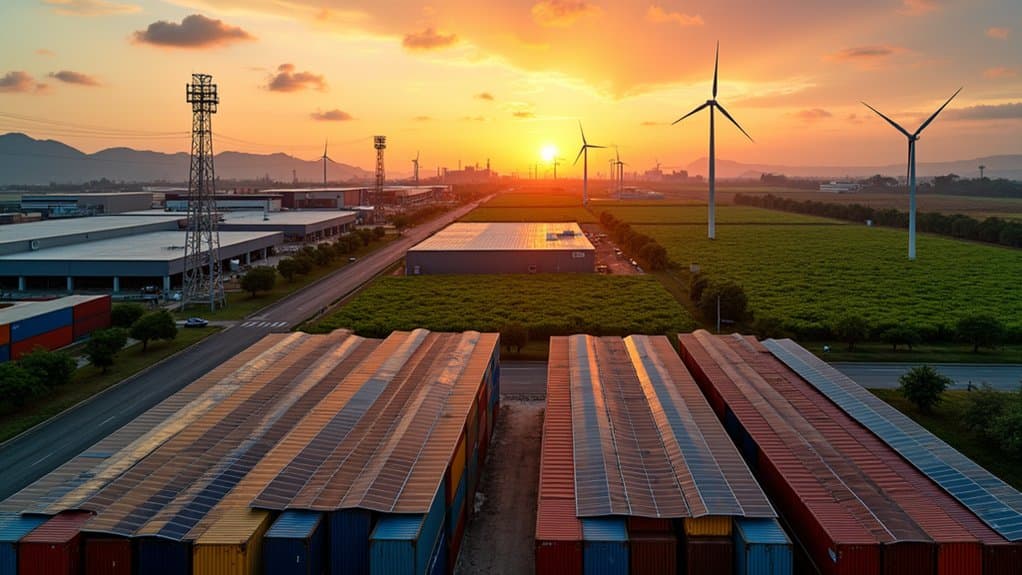
The first time a client told me he wanted to invest in "Dominican tourism," I handed him a map of the Free Trade Zones around Santiago and asked him to find them. He couldn't. Most people can't. They know where the beaches are, sure. They can locate Punta Cana with their eyes closed. But the industrial parks processing medical devices worth $2.8 billion annually? The cold storage facilities near Puerto Plata that can't keep up with demand? The solar farms spreading across Montecristi because Law 57-07 makes them more profitable than rental condos?
That's the story nobody tells you until you're sitting in my office, and by then you've usually already wasted six months looking at beachfront listings that'll never cash flow the way you hoped.
I've been practicing law here since 1986. Forty years of watching foreign money chase the wrong opportunities because they confused "what tourists see" with "where the economy actually moves." In 2024, the Dominican Republic grew by 5.0% while the rest of Latin America averaged 2.3%. That gap isn't coming from all-inclusive resorts. It's coming from the fact that this country quietly became the medical device manufacturing hub of the Western Hemisphere, the third-largest gold producer you've never heard of, and a logistics crossroads that can reach 900 million consumers via free trade agreements most investors don't even know exist.
This isn't a travel guide. It's a breakdown of where institutional capital is actually flowing, which laws make it possible, and what you need to know before you wire money to a country that most people still think runs entirely on mojitos and merengue.
Key Takeaways
- Manufacturing Dominance: Medical device exports reached approximately $2.8 billion in 2024, representing roughly 31% of Free Zone exports—making this the country's leading export sector, not tourism.
- Infrastructure Advantage: With 8 international airports and 12 seaports offering 2-3 day transit to the US East Coast, the DR functions as a nearshoring alternative to Asian manufacturing.
- Tax Arbitrage: CONFOTUR (Law 158-01) provides 15-year exemptions on the 3% transfer tax and 1% annual property tax; Law 57-07 offers 100% import duty exemptions plus a 75% tax credit for renewable energy generation projects—and a separate 40% tax credit if you're manufacturing the equipment itself within the DR.
- Residency Access: The $200,000 investment threshold for residency is real, but the 180-day registration window with ProDominicana is non-negotiable—miss it and you lose capital repatriation rights.
- North Coast Shift: Sosua and Cabarete are transitioning from tourism-dependent towns to logistics and tech hubs, with rental yields averaging 6-9% but requiring Starlink, backup power, and verified Deslinde titles.
The Economic Foundation Nobody Mentions
The Dominican Republic is the seventh-largest economy in Latin America. That fact alone tells you nothing useful. What matters is this: Moody's upgraded the country's credit rating to Ba2 (Stable) on August 1, 2025, citing "robust economic growth" and institutional improvements. Translation: The bond market thinks the government is getting its act together.
Here's what that looks like in practice. Inflation hit 3.35% in December 2024—the lowest in six years. The peso trades between 60-63 to the dollar, stable enough that real estate transactions happen in USD without anyone flinching. Foreign reserves are at record levels. The IMF projects this country will be the third wealthiest per capita in Latin America by 2028, ahead of Brazil and Mexico.
You don't get those projections from beach resorts. You get them from 87 industrial parks hosting 820 companies in Free Trade Zones. From $8.06 billion in exports from those zones in 2023 alone. From the Port of Caucedo expanding capacity to 3.1 million TEUs after a $760 million investment by DP World and the Dominican government. From Barrick Gold running one of the largest gold mines in the world at Pueblo Viejo.
Tourism contributes 16-19% of GDP. Manufacturing and construction are growing faster. That's the structural shift most investors miss because they're still reading articles about "Caribbean paradise" instead of looking at export data.
Where Smart Money is Actually Moving
The Logistics Play
In July 2024, the government passed Law 30-24. Nobody outside the logistics industry paid attention. They should have. It establishes the legal framework for the country to function as a "Logistics Hub"—not just moving goods through ports but performing value-added services like labeling, packaging, and light assembly on goods in transit without paying import duties. This law created the National Logistics Council and provides legal certainty that's distinct from standard Free Trade Zone regulations.
I've had three clients in the last year pivot from vacation rental investments to warehouse acquisitions near Puerto Plata. One of them is a German who initially wanted a beachfront condo in Cabarete. We ran the rental yield numbers—realistic ones, not the 12% fantasy numbers developers pitch—and he realized he'd be lucky to net 6% after HOA fees, maintenance, and seasonal vacancy. Then I showed him a 5,000 square meter warehouse facility with a 15-year lease to a cold storage operator serving the cruise ship supply chain. He's clearing 8.5% annually with zero tenant turnover risk.
Cold chain storage demand in the Cibao region has risen 30% year-over-year. Why? Because the DR is the world's number one exporter of organic cocoa and a top-five exporter of organic bananas to the EU. Those products need refrigerated storage before they hit the ports. The infrastructure hasn't kept up. That's the opportunity.
The Renewable Energy Angle
Law 57-07 is the most underutilized investment tool in this country. It provides 100% exemption on import duties for solar panels, wind turbines, and batteries. It also gives you a tax credit of up to 75% of your equipment investment for energy generation projects, deductible against income tax.
But here's what almost nobody knows: If you're manufacturing renewable energy equipment within the DR—not just installing it, but actually producing solar panels, wind turbine components, or batteries—Law 57-07 offers a separate 40% tax credit under Article 14, plus 100% exemption on import duties for raw materials. That provision exists to stimulate local industrial capacity. Almost no one is using it yet.
The Northwest region—Montecristi, parts of Puerto Plata—has average wind speeds exceeding 8.5 meters per second. That's higher than most of the US Midwest. Yet the renewable energy capacity here is nowhere near saturation. The National Energy Plan targets 25% renewable generation by 2025 and 30% by 2030. They're behind schedule.
A Dutch client of mine spent 18 months navigating land easements and environmental permits for a 20MW solar farm in Montecristi. The bureaucratic friction was real—permit delays, unclear zoning rules, the usual Dominican inefficiency. But once operational, his tax-adjusted ROI is projected at 14% annually because of Law 57-07 incentives. That's before factoring in the inevitable electricity rate increases.
The Agriculture Export Game
The Cibao Valley isn't sexy. It's hot, dusty, and far from any beach. It's also where the real agricultural money is made. The DR is the second-largest avocado producer globally after Mexico, with export values exceeding $80 million annually. Organic cocoa exports are even bigger.
A Canadian investor I work with bought 50 hectares of agricultural land near Santiago three years ago. He planted Hass avocados for export to the US under the DR-CAFTA agreement. The operation qualified for Article 17 of Law 158-01 (CONFOTUR) because the processing facility serves the tourism supply chain—hotels buy the avocados for their restaurants. That means he's exempt from the 1% property tax and got a 15-year break on the 3% transfer tax when he bought the land.
His mistake? Underestimating water access issues. Irrigation infrastructure in the Cibao is inconsistent. He ended up drilling two wells and installing solar-powered pumps. That added $120,000 to his upfront costs. But the yields are strong—6-8 tons per hectare at maturity, selling at $2-3 per kilogram to US distributors. His break-even is projected at year five.
The North Coast Reality Check
Puerto Plata, Sosua, Cabarete. These towns get lumped together in real estate marketing, but they're not interchangeable.
Puerto Plata is the logistics engine. Two million cruise passengers came through Taino Bay and Amber Cove in 2024. Gregorio Luperón International Airport saw a 12% increase in passenger arrivals in Q1 2024 compared to Q1 2023. The city is expanding port capacity and industrial infrastructure. If you're looking at commercial real estate or workforce housing, this is the zone.
Sosua is transitioning. It used to be a nightlife town with a reputation problem. Now it's gated communities catering to North American retirees and expats. Sosua Ocean Village, Sea Horse Ranch—these developments have the highest density of gated security on the North Coast. The real estate here is undervalued compared to what you'd pay in Tulum or Costa Rica. Entry-level investment properties still exist in the $160,000-$220,000 range. But rental yields are lower than Cabarete because the tourist demographic skews older and less active.
Cabarete is where the money moves faster. It's the water sports capital—kitesurfing, windsurfing, the Master of the Ocean tournament every February. That brings a high-net-worth demographic that converts to property buyers. Average occupancy rates for managed condos hover around 65-75% annually, spiking to 90%+ during wind season (January-March, June-August). A standard two-bedroom condo rents for $1,300/month long-term or higher as a short-term vacation rental.
The infrastructure has improved. Starlink solved the internet problem—speeds over 150 Mbps are now standard, which is why you see so many remote workers here. But electricity remains unstable. Backup power is mandatory. Solar ROI is under three years now because of Law 57-07 incentives and rising utility rates.
Here's the trap: Not all properties in Cabarete qualify for short-term rentals. Some HOA bylaws ban them outright. I caught that issue for a Toronto buyer last year—clause 17.3 in his condo's bylaws had been amended in 2022 to prohibit Airbnb-style rentals. He would've bought a property with rental projections that failed on day one.
The Legal Framework That Protects You (Or Doesn't)
The Deslinde Mandate
Law 108-05 requires GPS demarcation of property boundaries—the "Deslinde." Properties without this cannot be financed by banks and have cloudy titles. I've seen foreign buyers purchase land with only a "Carta Constancia" (an un-demarcated title) because a developer convinced them it was "good enough." It's not. You will spend years and tens of thousands of dollars in legal fees trying to clear that title later.
Before you sign anything, request the Title Certificate Number and verify the Deslinde status at the local Registry Office. If the seller hesitates, walk away.
CONFOTUR: The 15-Year Tax Break
CONFOTUR (Law 158-01) is the most powerful tax incentive in the country, but it's misunderstood. The benefit applies to the project, not the buyer. You need to verify that the development has an active "Definitive Classification" from the Ministry of Tourism (MITUR) before you purchase.
If the project qualifies, you're exempt from the 3% transfer tax at closing and the 1% annual property tax (IPI) for 10-15 years. On a $300,000 condo, that's $9,000 saved immediately plus roughly $3,000 annually in property taxes—over $50,000 in total savings over 15 years.
The catch: CONFOTUR only applies to newly approved properties. If you're buying resale, the exemption doesn't transfer unless the original buyer never used it. Most developers don't explain this clearly because they're focused on closing the sale.
Residency and the 180-Day Window
Foreign Investment Law 16-95 requires you to register your investment with ProDominicana within 180 calendar days of the funds entering the country. Miss that window and you lose the right to repatriate capital and profits. The registration—the Certificate of Foreign Investment—is mandatory to guarantee your legal right to move money back out of the country in foreign currency. I've seen investors blow this deadline because they didn't know it existed.
The $200,000 investment threshold for the "Investor Visa" is real. You need proof of foreign currency entry (wire transfer records), translated and apostilled corporate documents, and a completed application form. The process takes 4-6 months for approval if you submit everything correctly the first time. If you don't, expect delays.
The Pensionado (retiree) track requires proof of $1,500/month income ($250 per dependent). It's faster and cheaper than the investment route if you qualify. Dual citizenship is permitted under Article 20 of the Dominican Constitution, so you don't lose your original passport.
How the DR Stacks Up Against the Competition
Let's be direct. If you're comparing the DR to Dubai, Portugal, or Mexico, you need to understand the trade-offs.
Dubai offers zero income tax, but property prices are high and the legal system is opaque for foreigners. Portugal ended its NHR (Non-Habitual Resident) tax scheme in 2024, so the tax arbitrage play is gone. Mexico's Tulum market is saturated—net rental yields have compressed to 4-6% because of oversupply.
The DR offers lower entry prices ($160,000-$220,000 for prime North Coast properties), higher rental yields (6-9% realistic, not the 12% fantasy numbers), and tax incentives that are still fully active. Prime beachfront real estate in Cabarete averages $2,500-$3,500 per square meter. Compare that to $8,000+ in Miami or $5,000+ in the Cayman Islands.
The cost of living here is 68% lower than the United States and 40% lower than Puerto Rico. The DR has better air connectivity to the US East Coast than any Caribbean nation except Puerto Rico. The minimum wage in Free Trade Zones is $240-$300/month, keeping operational costs competitive with Mexico ($350+) and Costa Rica ($600+).
The downside? Bureaucratic friction. Obtaining construction permits can take 180+ days outside of CONFOTUR projects. Electricity distribution losses hit 42.6% in the first three quarters of 2023, according to reports from the Regional Center for Sustainable Economic Strategies (CREES) and the National Business Council (CONEP)—meaning reliable backup power is mandatory. Traffic accidents are high—defensive driving is not optional. Water pressure is inconsistent; properties need cisterns and roof tanks (tinacos).
Title fraud exists. Squatter rights favor tenants. Evicting a non-paying tenant without a rigorous contract can take 6-12 months. These are real risks. But they're manageable if you work with competent legal counsel and do proper due diligence.
What Can Go Wrong (And How to Avoid It)
The Pre-Construction Scam
Developers pitch "pre-construction" deals with 20-30% discounts. Some of these are legitimate. Many are not. The red flag: No fiduciary (fideicomiso) structure holding funds in escrow until construction milestones are met.
I've seen investors wire $50,000 deposits directly to a developer's personal account. The project never breaks ground. The developer disappears. The investor has no legal recourse because the contract was structured as a "promesa de venta" (promise of sale) with no escrow protection.
If a developer refuses to use a bank-managed fideicomiso, walk away. No exceptions.
The Rental Yield Fantasy
Developers advertise 10-12% rental yields. Those numbers assume 100% occupancy, zero maintenance costs, and no management fees. None of those assumptions are realistic.
Actual net rental yields on the North Coast—after HOA fees (which are high in gated communities like Sosua Ocean Village or Sea Horse Ranch), property management (typically 20-25% of gross rent), maintenance, and seasonal vacancy—range from 6-9%. Premium properties in Cabarete can hit the upper end of that range, but only if you're managing them aggressively and reinvesting in upgrades.
If someone pitches you double-digit yields, ask for audited financials from existing units in the development. If they can't produce them, assume the numbers are fiction.
The Electricity Problem
Electricity in the DR is unreliable. Distribution losses exceeded 42% in 2023. Power outages are frequent, especially during summer months when demand spikes.
Every investment property needs backup power. A generator costs $3,000-$8,000 depending on capacity. Solar with battery storage costs $15,000-$25,000 for a typical residential system. But with Law 57-07 incentives and rising utility rates, solar ROI is now under three years.
If you're buying a property without backup power already installed, budget for it immediately. Tenants will not tolerate frequent outages.
The Due Diligence Checklist
Before you wire money, verify these items:
Title Verification: Request the "Matrícula" (Title Number) and verify it at the local Title Registry Office (Registro de Títulos). Confirm the Deslinde status—GPS demarcation is mandatory under Law 108-05. Banks will not finance, and you cannot obtain a clear title transfer, for properties that only possess a "Carta Constancia" without a registered Deslinde.
Tax Status: Request an "IPI Certification" (IPI al día) proving the seller owes no back taxes on the property. Unpaid taxes transfer to the buyer at closing.
Zoning Compliance: For development land, check the "Uso de Suelo" (Land Use) certificate from MITUR. Ensure the land is zoned for your intended use—residential, commercial, or agricultural.
HOA Bylaws: If buying a condo, review the HOA bylaws for rental restrictions. Some developments ban short-term rentals outright.
CONFOTUR Status: If the developer claims CONFOTUR benefits, verify the project's "Definitive Classification" with MITUR. Get it in writing.
Escrow Structure: For pre-construction deals, confirm the developer is using a bank-managed fideicomiso. Verify the bank's name and account details independently.
Survey: Hire an independent Agrimensor (surveyor) to confirm the GPS coordinates match the physical fence lines. Boundary disputes are common.
Closing Costs: Budget 3% for transfer tax (unless CONFOTUR-exempt) plus 1-1.5% for notary and legal fees. Total closing costs are typically 4.5%.
Funds Transfer: Send all funds via bank wire to a registered escrow account to comply with Anti-Money Laundering Law 155-17. Cash transactions over $10,000 trigger reporting requirements.
The Long-Term Outlook
The IMF projects the DR will reach "High Income" status by 2030 if current growth rates persist. That's not a guarantee, but it's a signal. Foreign Direct Investment hit $4.38 billion in 2023 and is projected to exceed $4.5 billion in 2024. Institutional capital is moving in—not for beach condos, but for logistics infrastructure, renewable energy, and agricultural export operations.
The country has 8 international airports and 12 seaports. It's the only country in the region with free trade access to both the US (via DR-CAFTA) and Europe (via EPA), reaching a combined market of 900 million consumers. That's a structural advantage no amount of political instability can erase.
The North Coast is evolving. Sosua and Cabarete are no longer just tourist towns. They're becoming logistics nodes and tech hubs. Puerto Plata is expanding port capacity and industrial infrastructure. The demographics are shifting—fewer spring breakers, more remote workers and retirees with $200,000+ to invest.
But here's the reality: This market doesn't reward passive investors. If you're expecting to buy a condo, hire a property manager, and collect checks while sipping piña coladas in Toronto, you'll be disappointed. The infrastructure gaps, bureaucratic friction, and legal complexities require active management and competent local counsel.
If you approach it with realistic expectations, proper due diligence, and a willingness to navigate the inefficiencies, the DR offers stable, USD-denominated returns in a market that's still undervalued compared to its regional peers.
Frequently Asked Questions
Is buying property in the Dominican Republic safe for foreigners?
Foreigners have equal rights to land ownership under Law 16-95. You don't need a fideicomiso (bank trust) to buy near the coast like in Mexico. But "safe" depends on due diligence. Verify the Deslinde, check for liens at the Title Registry, and use a competent attorney. Title fraud exists, but it's avoidable if you follow proper procedures.
How does the residency by investment process work?
You invest a minimum of $200,000 in real estate or a business, register the investment with ProDominicana within 180 days, and apply for the Investor Visa. The process takes 4-6 months if your paperwork is correct. After obtaining residency, you can apply for naturalization in as little as 2 years (versus the standard 7-year track). Dual citizenship is permitted.
Can I use a self-directed IRA to invest in DR real estate?
Yes. US citizens can use a Self-Directed IRA (SDIRA) to purchase DR real estate, provided the property is for investment only—not personal use. You'll need a custodian who allows international real estate investments. The property must generate income (rental or resale) within the IRA, and all expenses must be paid from IRA funds.
What are the realistic closing costs?
Budget 3% for the transfer tax (unless the property is CONFOTUR-exempt) plus 1-1.5% for notary and legal fees. Total closing costs typically run 4.5% of the purchase price. If you're financing through a local bank, add another 1-2% for loan origination fees. Local banks (Scotiabank, Banco Popular) offer mortgages to foreigners at 70% LTV for up to 25 years, but rates are higher than in the US or Canada—expect 8-10% annually.