

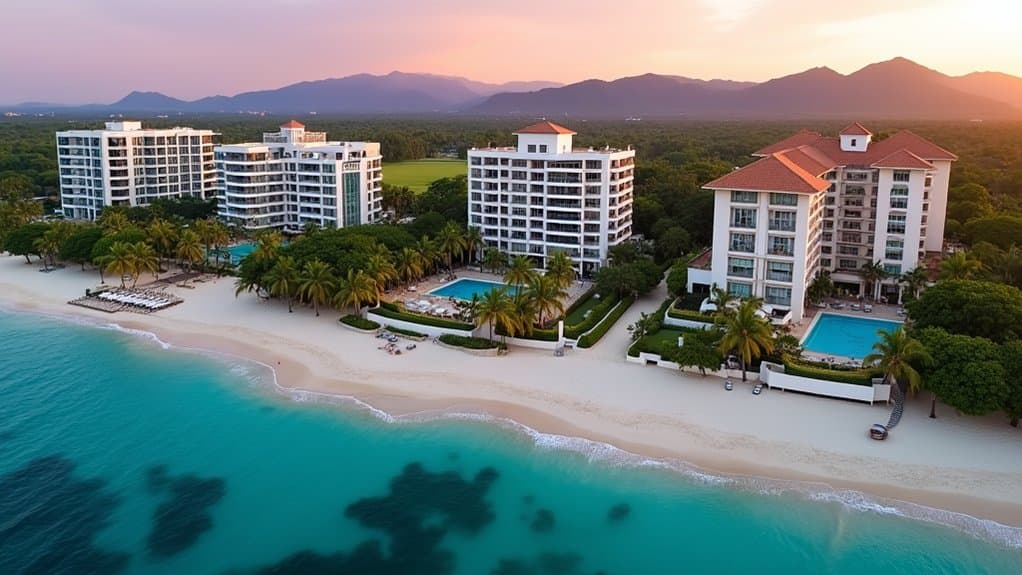
Last Tuesday, a German couple walked into my office with a glossy brochure showing a beachfront condo that looked identical to something you'd find in Dubai Marina. They were ready to wire the deposit. I asked one question: "Did your broker show you the Deslinde?" They stared at me like I'd spoken Mandarin. That's the problem with comparing markets on Instagram. A beachfront condo in Sosua and one in the UAE might both have infinity pools and ocean views, but the legal framework, the operational reality, and the actual mechanics of making money are completely different species.
The Dominican Republic's North Coast is sitting in a strange window right now. Tourism hit 11.2 million visitors in 2024—a record. Cruise arrivals jumped 22% in January 2025 alone. Meanwhile, you can still buy oceanfront property here for $220 to $350 per square foot, roughly half of what comparable beachfront costs in Dubai ($450+) or Lisbon ($500+). The government is actively courting foreign capital with 15-year tax exemptions under Law 158-01 (CONFOTUR), and nearly every transaction happens in US dollars, which shields you from the peso's 3-4% annual depreciation against the greenback.
But here's what the brochures don't tell you: rental yields of 7% to 12% are real, but they come with a cost structure most foreign investors never see coming. Salt air will destroy your AC condenser in three years instead of ten. Your balcony railings will rust within 18 months unless they're marine-grade 316L stainless steel. The local utility provider, Edenorte, has improved significantly but still can't promise you won't lose power for a few hours a week during peak season. And if you buy a property without a verified Deslinde—the GPS-surveyed title that Law 108-05 requires—you might as well have bought a timeshare presentation.
After two decades selling real estate on this coast and working with Lic. Guido Luis Perdomo Montalvo, who has been practicing law here since 1986, we have seen the full spectrum: the investors who made 14% returns and retired early, and the ones who are still fighting boundary disputes five years later because they trusted a handshake over a title search. This isn't a listicle of "Top 5 Best Condos." This is a breakdown of which developments actually deliver on their promises, which ones are hiding maintenance disasters, and how to calculate real ROI when you factor in the operational realities of owning property 300 meters from the Atlantic.
Key Takeaways
- Rental Yield Reality: Well-managed beachfront condos in Sosua deliver gross yields of 6-9%, with top performers hitting 12% during high season (December-April). Net yields after expenses typically settle at 5-7%.
- CONFOTUR Tax Advantage: Properties approved under Law 158-01 are exempt from the 3% transfer tax and the 1% annual IPI property tax for 15 years, saving approximately $54,000 on a $300,000 condo over that period.
- Infrastructure Dependency: Backup generators are mandatory, not optional. Properties without reliable power lose rental appeal to digital nomads. Starlink (RD$2,900/month, ~$48 USD) has become a competitive advantage for occupancy rates.
- Legal Due Diligence: Never purchase without a Deslinde (GPS-verified title survey required under Law 108-05). An estimated 15-25% of DR property transactions involve title irregularities that can invalidate ownership.
- Maintenance Premium: Budget 1.5-2% of property value annually for maintenance—higher than the standard 1%—due to aggressive salt corrosion. HOA fees for beachfront properties typically run $300-$700/month.
The Corrosion Factor: Why "Direct Oceanfront" Has a Hidden Price Tag
When clients ask me about the difference between a condo 50 meters from the beach versus one directly on it, I pull out my phone and show them photos of balcony railings. The ones on direct oceanfront properties look like they've been through a chemical attack. Because they have.
The prevailing East Trade Winds carry salt spray inland at concentrations high enough to corrode standard galvanized steel within 12 to 18 months. Your air conditioning condensers, which normally last a decade inland, will fail in five years—maybe three if they're facing the wind. Window frames oxidize. Door hinges seize. Even your garden irrigation system will require 20% more water because the salt dries out the soil faster than normal.
This isn't cosmetic. I have watched investors budget $2,000 per year for maintenance, only to discover they need to replace all their balcony railings for $5,000 in year two. The developments that understand this use marine-grade 316L stainless steel or anodized aluminum for all exterior fixtures. The ones that don't are essentially selling you a ticking maintenance bomb.
Here's the operational reality: properties within the 300-meter "salt zone" experience corrosion rates roughly 10 times higher than those set back from the ocean. That's not an exaggeration. It's chemistry. And it means your actual net ROI calculation needs to include replacement cycles for every piece of metal and electronics exposed to the elements.
The smart developers build this into their HOA fees. The less experienced ones don't, and you find out three years later when the HOA levies a special assessment of $3,000 per unit to replace the building's corroded exterior railings. I have seen this exact scenario play out at older developments near Playa Alicia.
Infrastructure: The Grid, The Generator, and The Internet
Sosua runs on Edenorte, the regional utility provider. Unlike Las Terrenas, which has its own grid managed by Luz y Fuerza, we are part of the larger North Coast system. The good news: reliability has improved significantly over the past five years. The bad news: it is not perfect.
During peak tourist season, when every condo is running AC units at full blast, you will lose power. Sometimes for an hour. Sometimes for four. Sometimes overnight. This is not a political statement or a complaint about the government—it is just the operational reality of a developing grid under heavy seasonal load.
If you are renting to digital nomads or remote workers—which is where the highest yields are right now—a full-load backup generator is not a luxury. It is a mandatory requirement. Your tenants will not tolerate losing power during a Zoom call with their boss in New York. They will leave you a one-star review, and your occupancy rate will drop 15-20% compared to competitors who have reliable backup systems.
The math: a proper generator installation costs $8,000 to $12,000 depending on the size of the unit. Fuel costs vary, but budget around $100-$150 per month if you are running it a few hours a week during outages. That is an operational expense most investors do not factor into their yield calculations until they realize their property is sitting empty in February—peak season—because the last tenant complained about the power going out.
Water is a similar story. Municipal pressure is inconsistent. Most beachfront developments in Sosua rely on cisterns and trucked water delivery as a backup. If your HOA is well-managed, this is invisible to you. If it is not, you will get calls from tenants complaining about low water pressure during their shower.
Then there is internet. Fiber optic is available in central Sosua through Claro and Altice, offering speeds up to 100-300 Mbps. But if your property is in a more secluded beachfront area, you might still be relying on slower DSL or cable. That is where Starlink has become a game-changer. The hardware costs around RD$27,000 ($450 USD), and the monthly service is RD$2,900 (about $48 USD). Properties with Starlink installed are seeing 15-20% higher occupancy rates from work-from-anywhere tenants compared to those relying solely on local providers.
I tell every investor the same thing: budget for infrastructure independence. The developments that have backup power, reliable water systems, and high-speed internet are the ones commanding premium nightly rates and maintaining 60-70% year-round occupancy.
The Five Developments: What Actually Delivers
Sosua Ocean Village (SOV)
This is the 800-pound gorilla of the Sosua market. Massive. Over 400 units when fully built out. Water park. Multiple pools. Gym. Beach club. It is the closest thing the North Coast has to a self-contained resort ecosystem.
Rental Performance: Units here are delivering gross yields of 10-12%, which is on the high end for the market. The amenities drive occupancy, especially for families. A well-furnished two-bedroom can pull in $150-$200 per night during peak season (December-April), dropping to $80-$100 in the low season (September-October).
The Risk: Competition. You are not just competing with other Sosua properties—you are competing with hundreds of units within the same complex. If your furnishings are mediocre or your photos are bad, you will sit empty while the unit two floors down stays booked. The market here rewards professionalism. Top-performing owners hire full-time property managers who stage the units like showrooms and respond to inquiries within minutes.
Infrastructure: SOV has its own backup generators and water systems. The HOA is well-funded and professionally managed, which is critical. Monthly fees run around $350-$500 depending on the unit size, which is reasonable given the amenities.
CONFOTUR Status: Most units qualify for CONFOTUR benefits, meaning you are exempt from the 3% transfer tax on purchase and the 1% annual IPI property tax for 15 years. On a $300,000 condo, that is an immediate $9,000 savings at closing and $4,500 per year in tax savings—roughly $67,500 over the full term.
Who Should Buy Here: Investors focused on short-term rental income who are willing to invest in top-tier furnishings and professional management. This is not a "set it and forget it" property. It is a business that requires active oversight.
Infiniti Blu
This development positions itself as the quieter, more upscale alternative to SOV. Smaller. More boutique. Strict HOA rules that limit noise and party rentals.
Rental Performance: Yields here are slightly lower—6-8%—but the tenant profile is different. You attract longer-term renters (one to three months) and retirees who value tranquility over nightlife proximity. Nightly rates are similar to SOV during peak season, but occupancy dips more sharply in the low season because you are not pulling the "party crowd" or families looking for water parks.
The Risk: The strict HOA rules are a double-edged sword. They maintain property values and reduce wear-and-tear, but they also limit your rental flexibility. If you were planning to market to bachelor parties or large groups, this is not the place.
Infrastructure: Excellent. Backup power. Fiber internet. Well-maintained common areas. The HOA fees are higher—$500-$700 per month—but you are paying for a premium product.
CONFOTUR Status: Verified. Full 15-year exemptions apply.
Who Should Buy Here: Investors targeting long-term, high-quality tenants or those planning to use the property themselves for extended periods. This is also a solid option if you are considering eventual retirement here and want a quieter environment.
Hispaniola Beach
This is one of the older developments in Sosua, located right on Playa Alicia. Walking distance to town. Private beach access. It has the location advantage that newer developments further out lack.
Rental Performance: Yields of 9-11%. The location drives demand. Tenants can walk to restaurants, bars, and the main beach without needing a car, which is a significant selling point for short-term renters.
The Risk: Age. The buildings here are older, which means higher maintenance levies are likely as infrastructure ages. I have seen HOAs at similar properties levy special assessments for roof repairs, elevator replacements, and exterior painting. Budget an extra $1,000-$2,000 per year for unexpected capital expenditures.
Infrastructure: Backup generators exist but are older. Internet is reliable (fiber available). The HOA is functional but not as polished as SOV or Infiniti Blu.
CONFOTUR Status: Some units qualify, but verify individually. Resale units may not carry the exemption if the original buyer did not structure the purchase correctly.
Who Should Buy Here: Investors who value location over modern amenities and are comfortable managing the risks of an older building. This is also a good option for buyers who want walkability and do not want to rely on a car.
Ocean Tree Residences
This is a newer development, still in the final phases of construction. Modern design. High ceilings. Open floor plans.
Rental Performance: Projected yields of 9-11%, though actual performance data is limited since many units are still being delivered.
The Risk: New construction in the Dominican Republic comes with delays. I have seen projects finish six to twelve months late due to material import logistics, permit delays, or contractor issues. If you are buying pre-construction here, verify that the "Promise of Sale" contract includes penalty clauses for delivery delays. Most do not, which means you have no recourse if the developer misses the deadline.
Infrastructure: Promises are excellent—backup power, fiber internet, modern water systems. The question is execution. New buildings often have "teething issues" in the first year as systems are debugged.
CONFOTUR Status: Approved. Full exemptions apply.
Who Should Buy Here: Buyers who want modern finishes and are comfortable with the risks of new construction. This is also a good option if you are planning to hold the property long-term and can wait out any initial delivery delays.
Perla Marina
Located between Sosua and Cabarete, this is a gated, secure development with ocean views but not direct beach access. You are set back from the water, which reduces maintenance costs but also limits the "beachfront" appeal.
Rental Performance: Yields of 8-10%. The gated security is a selling point for families and long-term renters, but short-term tourists often prefer direct beach access.
The Risk: Location. You are not walkable to Sosua town, which means tenants need a car. This limits your pool of potential renters, especially younger travelers or digital nomads who rely on taxis or walking.
Infrastructure: Solid. Backup power. Reliable water. The HOA is well-managed and the fees are reasonable ($300-$400/month).
CONFOTUR Status: Verified. Full exemptions apply.
Who Should Buy Here: Investors targeting long-term tenants or families who value security and do not mind being car-dependent. This is also a good option if you want lower maintenance costs (less salt exposure) and are willing to trade that for slightly lower rental yields.
| Development | Gross Yield | HOA Fees (Monthly) | Best For | Key Risk |
|---|---|---|---|---|
| Sosua Ocean Village | 10-12% | $350-$500 | Short-term rentals, families | High internal competition |
| Infiniti Blu | 6-8% | $500-$700 | Long-term tenants, retirees | Strict HOA rules limit flexibility |
| Hispaniola Beach | 9-11% | $300-$500 | Walkability, location value | Older building, higher maintenance |
| Ocean Tree Residences | 9-11% (projected) | $350-$500 (estimated) | Modern finishes, long-term hold | Construction delays, new building issues |
| Perla Marina | 8-10% | $300-$400 | Families, long-term tenants | Not walkable, car-dependent |
The Financial Reality: DR vs. Dubai vs. Portugal
The numbers look compelling on paper. Dominican Republic beachfront properties average gross yields of 7.78% as of Q1 2025, outperforming Lisbon (around 4%) and competing closely with Dubai (6-9%). Entry costs are roughly half: $220-$350 per square foot in Sosua versus $450+ in Dubai and $500+ in Lisbon.
But raw yield numbers do not tell the full story. You need to account for operational costs that vary dramatically by market.
In Dubai, you have zero property tax—period. In Portugal, you are dealing with IMI (property tax) and the recent elimination of the NHR tax breaks for many pensioners. In the Dominican Republic, you have CONFOTUR, which gives you zero property tax for 15 years on approved properties, but only if you buy the right unit in the right development.
Here's the actual math on a $300,000 beachfront condo in Sosua with CONFOTUR benefits:
- Transfer Tax Savings: $9,000 (3% exemption at purchase)
- Annual IPI Tax Savings: $3,000 per year (1% exemption)
- Total 15-Year Savings: $54,000
That is real money. It directly improves your cash flow and reduces your break-even point by six to twelve months compared to a non-CONFOTUR property.
But you also have higher operational costs than Dubai or Portugal. Maintenance runs 1.5-2% of property value annually instead of the standard 1% due to salt corrosion. HOA fees are higher. Generator fuel costs add up. And if you are renting short-term, property management fees typically run 20-25% of gross income.
The currency situation is a wash. Dubai transactions happen in AED (pegged to USD). Portugal uses EUR (subject to exchange rate fluctuations). The Dominican Republic uses USD for real estate transactions, which shields you from peso depreciation but also means you are not getting any currency arbitrage gains.
The residency path is where the DR shines. You can get permanent residency with a $200,000 real estate investment, compared to Dubai's Golden Visa requirement of around $545,000 and Portugal's heavily restricted Golden Visa program. If you are looking for a "Plan B" residency option, the DR offers one of the most straightforward paths in the Western Hemisphere.
The Legal Framework: What CONFOTUR Actually Means
Law 158-01 sounds complicated, but it is straightforward once you cut through the legal language. The Dominican Republic government wants to attract tourism investment, so they created a package of tax incentives for approved developments.
Here's what CONFOTUR actually gives you:
Transfer Tax Exemption: You pay zero transfer tax (normally 3% of purchase price) when you buy.
IPI Tax Exemption: You pay zero annual property tax (normally 1% of assessed value) for 10 to 15 years depending on the specific project approval.
Import Duty Exemption: Developers (and sometimes individual owners) can import furniture and equipment duty-free for the initial furnishing, though this is harder for individuals to claim than developers.
No New Taxes: The law guarantees that any new taxes imposed during your exemption period will not apply to your property.
What CONFOTUR does not give you:
Rental Income Tax Exemption: This is murky. While the law mentions income tax exemptions, the reality for foreign investors is more complex. Non-resident investors typically face a flat withholding tax of 27% on rental income (sometimes 29% depending on remittance structure) if they don't establish tax residency. Individuals who do qualify as tax residents are taxed on a progressive scale ranging from 15% to 25% based on annual income tiers. Some investors structure ownership through a Dominican corporation to access the 27% corporate rate, but this adds legal complexity and costs.
Capital Gains Tax Exemption: You are still subject to 25-27% capital gains tax when you sell, though the holding period exemptions apply.
The critical detail: not all properties qualify. The development must be specifically approved by the Tourism Development Council. If you buy a resale unit in a non-CONFOTUR project, you get zero exemptions. And if you buy in a CONFOTUR project but the seller did not structure the original purchase correctly, the exemptions may not transfer.
This is where the Deslinde comes in. Law 108-05 requires every property transaction to include a GPS-verified title survey before you can record the sale at the Title Registry. An estimated 15-25% of property transactions in the DR involve title irregularities—land that is not properly surveyed, boundary disputes with neighbors, or titles that are still in the name of someone who died twenty years ago.
I have watched foreign investors put down deposits on properties that looked perfect, only to discover during due diligence that the land was never deslindado or that the seller did not actually have clear title. In one case, a client was ready to close on a beachfront lot until we discovered the property encroached on the 60-meter maritime zone—the public domain that extends from the high-tide line. That purchase would have been void from day one.
The legal process is not complicated, but it is non-negotiable:
- Promise of Sale (Promesa de Venta): This is the binding contract that locks in the price and conditions, typically with a 10% deposit.
- Title Search (Certificación de Estado Jurídico): Your lawyer obtains a certificate from the Title Registry confirming there are no liens, mortgages, or judicial impediments on the property.
- Deslinde Verification: An independent surveyor verifies that the physical boundary markers match the GPS points on the title.
- IPI Tax Status Check: Confirm the seller is current on property tax payments. Unpaid taxes stay with the property, not the person.
- Closing: Transfer of title at the notary, with the buyer paying approximately 5% in closing costs (3% transfer tax if non-CONFOTUR + 1-2% legal/notary fees).
The cost of proper legal verification is typically 1-1.5% of the purchase price. On a $300,000 property, that is $3,000-$4,500. It is not optional. It is the difference between owning a secure asset and paying tuition in the form of a legal nightmare.
Who Should Actually Buy in Sosua
This market is not for everyone. If you are looking for G7-level political stability or instant liquidity like you would find in London or New York, this is not the place. The Dominican Republic is an emerging market with all the operational complexities that entails.
But if you fit one of these profiles, Sosua makes sense:
High-Yield Investors: You prioritize cash flow over prestige. You are comfortable managing operational complexity in exchange for 7-12% gross yields. You understand that higher returns come with higher operational oversight.
Cash Buyers: Financing in the DR is difficult for foreigners. Mortgage rates run 10-13%, and many lenders require 40-50% down. This is primarily a cash market, which also stabilizes prices against interest rate fluctuations.
Plan B Seekers: You want a residency option outside your home country. The $200,000 investment threshold for permanent residency is one of the lowest in the Western Hemisphere, and the process typically takes six to eight months.
Lifestyle Investors: You plan to use the property yourself for several months per year and want rental income to offset costs during the months you are not there. This is a common model for retirees who split time between the DR and North America or Europe.
Who should look elsewhere:
Passive Investors: If you want a completely hands-off investment where you wire money and never think about it again, this is not the market. Even with professional property management, you will need to stay involved in decision-making around maintenance, pricing, and tenant issues.
Leveraged Buyers: If you need financing to make the purchase work, the high interest rates in the DR will destroy your ROI. This is a cash market.
Risk-Averse Buyers: If the idea of power outages, salt corrosion, or navigating Dominican bureaucracy makes you uncomfortable, you are better off in a more established market even if the yields are lower.
The Noise vs. Seclusion Trade-Off
One variable most investors do not think about until they are sitting in their condo at 2:00 AM listening to reggaeton from the bar next door: location within Sosua matters as much as the development itself.
Properties near Pedro Clisante Street—the main nightlife strip—can experience noise levels exceeding 85 decibels until 3:00 AM. If you are marketing to young tourists or party groups, that is fine. They want to be in the middle of the action. But if you are targeting long-term tenants, digital nomads, or retirees, that noise will kill your occupancy.
Developments in Playa Laguna or the quieter sections of El Batey drop to ambient levels of 40-50 decibels (ocean sounds only). You lose the walkability to nightlife, but you gain a premium from tenants who value tranquility. In my experience, long-term renters (one to three months) will pay 10-15% more for a quiet location compared to a similar unit in the high-noise zone.
The walkability factor is also critical. Hispaniola Beach and some units in SOV are within walking distance to restaurants, grocery stores, and the main beach. Perla Marina and some of the more secluded developments require a car. That is not inherently bad, but it limits your tenant pool to people who are comfortable driving in the DR or who are willing to rely on taxis.
Sidewalks outside of gated communities are often non-existent or in disrepair. If your marketing materials promise "walk to town," make sure you have actually walked that route yourself at night. I have seen investors advertise walkability only to have tenants complain that the walk is unsafe after dark due to poor lighting and lack of sidewalks.
The Tuition-Free Path
Real estate tuition is expensive. I have watched investors lose $50,000 on boundary disputes, $30,000 on properties that were never properly titled, and $20,000 on maintenance disasters they did not see coming because they trusted the broker's photos instead of doing a physical inspection.
The German couple from the beginning of this article ended up not buying that condo. We ran the title search and discovered the property was still in the name of the original developer, who had gone bankrupt. The seller was trying to offload a unit he did not actually own. That $1,500 legal verification fee saved them $300,000.
If you are serious about buying beachfront property in Sosua, the process is straightforward but non-negotiable:
Work with a lawyer who specializes in real estate and has a direct relationship with the Title Registry. Lic. Guido Luis Perdomo Montalvo has been practicing here since 1986 and has contacts in the land office that can verify titles and deslindes quickly. That is not a sales pitch—it is operational reality. You need someone who can navigate the bureaucracy efficiently.
Verify CONFOTUR status independently. Do not take the developer's word for it. Have your lawyer confirm the project is approved and that the specific unit you are buying qualifies for the exemptions.
Budget for infrastructure independence. Factor in backup power, water systems, and internet upgrades. These are not optional extras—they are the difference between a property that rents at 70% occupancy and one that sits empty.
Inspect the property physically. Do not buy based on renderings or photos. Fly down. Walk the unit. Check the railings for rust. Turn on the AC. Test the water pressure. Look at the HOA financials to see if they have a sinking fund for major repairs.
Calculate real ROI. Use conservative occupancy assumptions (60% instead of 80%). Factor in maintenance costs at 1.5-2% of property value annually