

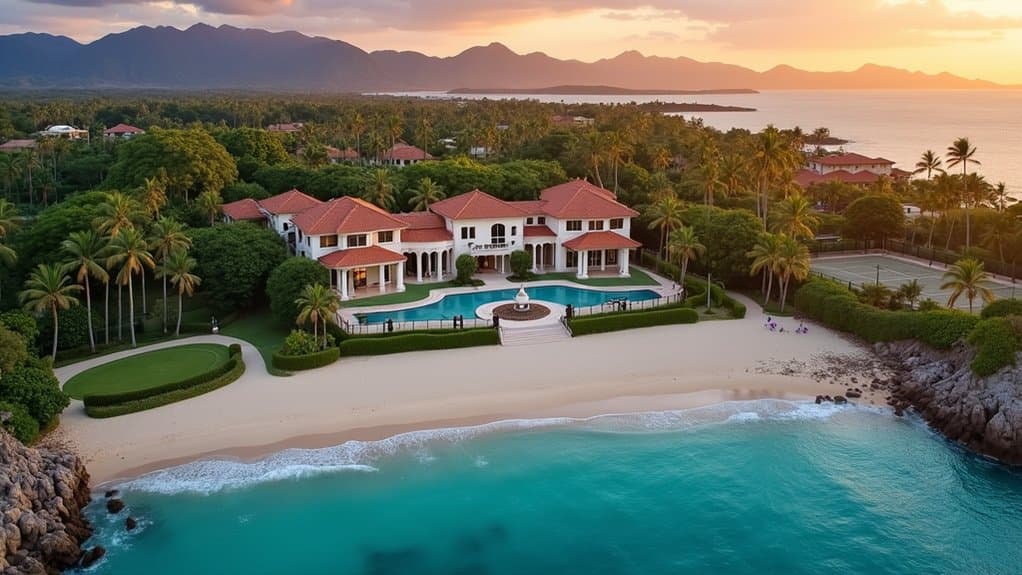
A couple from Toronto sat in my office last month with a spreadsheet. The developer had shown them a four-bedroom villa generating $180,000 in gross annual rental revenue. They were excited. The math looked simple: buy for $1.875 million, collect $180k a year, retire early on the beach.
I asked one question: "What's left after you pay everyone?"
Silence.
That's the problem with luxury real estate investment in the Dominican Republic. The marketing materials show you the top line. They don't show you the electric bill in August when the air conditioning runs 24/7. They don't mention that your property manager takes 30% before you see a dollar. And they definitely don't walk you through the reality that your villa will sit empty for two months during hurricane season while you still pay the HOA fees.
I've been doing title work in Sosúa and Cabarete since before Sea Horse Ranch had paved roads. The properties are beautiful. The returns can be solid. But only if you understand the actual cash flow, not the fantasy version.
Key Takeaways
- Real Returns: Conservative NOI analysis shows 4-6% cap rates for luxury villas in Sea Horse Ranch, not the 10-12% gross yields marketed in brochures.
- Total Investment: Your denominator for ROI calculations is approximately $2.13 million for a $1.875M villa—not the purchase price alone—after closing costs, furnishing, and immediate capital expenditures.
- The 50% Rule: Expect to keep only 50-55% of gross rental revenue as pre-tax Net Operating Income after management fees (25-35%), utilities ($14k+/year), and tropical maintenance costs.
- Seasonal Reality: Annual occupancy typically stabilizes at 55-60% due to severe low-season troughs (September-October) when rates drop 40% and bookings vanish.
- Legal Non-Negotiables: Law 108-05 requires a verified Deslinde (GPS boundary survey) for any property transfer in Sea Horse Ranch—buying without one is legally impossible as of 2009.
The Revenue Trap: Why Gross Income Is a Lie
You will hear developers say a luxury villa generates $180,000 a year. That sounds exceptional on a property trading under $2 million. But you cannot spend gross revenue.
After the property manager takes their cut, the government collects taxes, the electric company bills you for running pool pumps in 90-degree heat, and the air conditioner compressor dies (which it will, because salt air destroys electronics), that $180k starts to look more like $85k. And that's in a good year.
I've reviewed dozens of proformas for Sea Horse Ranch properties. The ones that sell fast are the ones with the most aggressive revenue projections. The ones that make money long-term are the ones where the owner budgeted for reality.
Net Operating Income is the only number that matters. It's what's left after you pay for everything except your mortgage. If you financed the property, NOI is what services your debt. If you paid cash, it's what you actually get to keep.
The Asset: What $1.875 Million Actually Buys You
Sea Horse Ranch is not a typical Caribbean development. It's a 250-acre master-planned resort that's been operating since the 1990s. The infrastructure is mature. The roads are paved. The security is legitimate—24/7 guards at the gate, not a guy in a lawn chair.
A representative four-bedroom villa with a private pool trades around $1.875 million in the current market. You get ocean views, proximity to the Equestrian Center, and access to the Beach Club. The property is turnkey in the sense that the structure exists and functions.
But turnkey doesn't mean ready to generate $180k in rental income. That requires a different level of investment.
The Real Denominator: Total Cash Invested
Here's where the math gets honest.
Purchase Price: $1,875,000
Transfer Tax (3%): $56,250
This is non-negotiable. The DGII (tax authority) calculates it based on either the government-appraised value or your purchase price, whichever is higher. For a clean transaction, I use the purchase price to avoid disputes.
Legal Fees (1.5% + 18% VAT): $22,125
Standard rate for a competent attorney to verify the title, confirm the Deslinde, pull the Status Juridico report, and ensure the IPI taxes are current. The 18% VAT on professional services is a separate line item many buyers forget.
Notary & Registry Fees: $1,500
Miscellaneous stamps, certifications, and filing fees at the Conservaduría de Hipotecas.
Luxury Furnishing Package: $150,000
This is not optional if you want to command $1,000+ per night. You're competing with other high-end villas. Guests expect imported mattresses, stainless steel appliances, and furniture that doesn't look like it came from a Santo Domingo warehouse. Import duties on quality furnishings are high—often 20-30% on declared value.
Immediate Capital Expenditures: $25,000
Most resale villas need immediate work. Pool pump replacement. AC compressor refresh. Exterior paint to fix where the tropical sun destroyed the finish. Budget for it upfront.
Total Cash Invested: $2,130,000
That's your denominator for ROI calculations. Not $1.875 million. You need $2.13 million in liquid capital to own this asset and have it ready to generate the revenue the brochure promised.
Where Every Dollar Actually Goes
The expense ledger for a luxury villa in Sea Horse Ranch is not a short document.
HOA Fees: $870 - $1,100 per month
Sea Horse Ranch charges based on lot size and bedroom count. For a four-bedroom villa, you're looking at roughly $900/month. This covers 24/7 security, garbage collection, road maintenance, landscaping of common areas, and a small credit toward the Beach Club restaurant.
Some owners complain about HOA fees. I don't. The alternative is living in a subdivision where the developer went bankrupt and the roads are now dirt. You're paying for reliability.
IPI (Property Tax): ~$17,000 annually
The Impuesto Patrimonio Inmobiliario is 1% of the property value above the annual exemption threshold. For 2026, that threshold is approximately 10.6 million DOP (roughly $178,000 USD). On a $1.875 million assessed value, you're paying around $17,000 per year if you hold the property personally.
Corporate structures or Confotur certification can reduce this, but those require separate analysis. For a straightforward cash purchase held in your name, budget for the full tax.
Electricity: $800 - $1,200 per month
This is the expense that shocks people. Electricity in the Dominican Republic is expensive and unsubsidized. Rates are tiered—once you cross 700 kWh per month, you're paying $0.24 to $0.30 USD per kilowatt-hour.
A four-bedroom villa with central AC, pool pumps running 12 hours a day, and modern appliances easily hits $1,000/month. In peak summer (July-August), when you need AC constantly to keep the property habitable, it can spike higher.
I tell clients: if you're not comfortable with a $1,200 electric bill, don't buy a luxury villa in the tropics.
Property Insurance: $6,000 - $8,000 annually
Comprehensive "All Risk" insurance covering hurricanes, earthquakes, fire, and liability typically costs about 1% of the replacement value of the structure (excluding land). For a high-end villa, that's $6k-$8k per year.
You cannot skip this. Hurricane season is real. I've seen uninsured properties take direct hits. The financial loss is catastrophic.
Staffing: $400 - $500 per month
A full-time gardener and pool maintenance technician is standard for luxury rentals. Monthly salary plus mandatory "Regalia" (13th-month pay) and potential liquidation rights if you terminate employment. Budget $450/month minimum.
Some owners try to skip this and handle maintenance themselves during visits. That works until a guest arrives to a green pool and leaves a one-star review.
Property Management: 25% - 35% of Gross Revenue
Full-service management includes marketing, guest communication, check-in/check-out, cleaning coordination, and maintenance oversight. The industry standard in Sea Horse Ranch is 30%.
On $180k gross revenue, that's $54,000 before you see a dollar.
You can self-manage to save this fee. But then you're answering WhatsApp messages at 2 AM when a guest can't figure out the AC remote. Most owners pay the fee.
Maintenance Reserve: 2% of Gross Revenue
The "Tropical Tax." Salt air corrodes metal. UV rays destroy plastic. Electronics fail faster in high humidity. You need a sinking fund specifically for replacing AC units, refrigerators, and TVs every 3-5 years.
On $180k gross, that's $3,600 annually set aside. It sounds excessive until the pool heater dies and the replacement costs $4,500.
Water & Internet: $100 - $150 per month
Fixed costs. High-speed fiber optic internet is mandatory for attracting digital nomad renters. Water is cheap but you still pay a monthly service fee.
Add it all up and you're looking at roughly $112,000 in annual operating expenses on the conservative end. On an optimized property generating $210k gross (which requires exceptional occupancy), your variable costs rise to about $125k.
The 50% Rule exists for a reason. Expect to keep half your gross revenue as NOI. Anything above that is exceptional performance.
Occupancy Reality: The Seasonal Tides You Cannot Escape
The North Coast has three seasons, not four.
High Season: December 15 - April 15
This is when you make your money. Occupancy hits 85-95% at peak rates. A well-marketed villa can command $1,200+ per night during Christmas and New Year's weeks. February is consistently strong due to the "Master of the Ocean" competition and general winter escape demand from North America.
You will generate 60-70% of your total annual revenue in these four months.
Shoulder Season: May, June, November
Occupancy drops to 40-50%. Rates discount by 20-30% to attract bookings. June-August has a unique secondary peak due to kitesurfing season (best wind conditions), but Sea Horse Ranch is slightly removed from Kite Beach, so the impact is lower than for properties directly on Cabarete Bay.
You're still profitable during shoulder months, but barely covering operating costs.
Low Season: September & October
The dead months. Peak Atlantic hurricane season. Occupancy can drop to 10-20%. Some weeks you get zero bookings.
This is when you schedule heavy maintenance—roof sealing, exterior painting, pool resurfacing—because the property is empty anyway. But you're still paying HOA fees, electricity for basic climate control, and insurance.
Many owners panic during low season and start slashing rates to $200/night just to get someone in the door. This is a mistake. It trains the market to expect discounts and damages your brand positioning.
Better strategy: accept the vacancy, use it for maintenance, and keep your rates firm so you don't devalue the asset.
A realistic, conservative annual occupancy model for a four-bedroom villa in Sea Horse Ranch is 55-60%. Anything above 65% is exceptional and usually requires aggressive marketing, Superhost status on multiple platforms, and differentiation (private chef included, ultra-modern interior, etc.).
The Math: What You Actually Keep
Let's run two scenarios.
Scenario A: Conservative Performance
- Average nightly rate: $900
- Annual occupancy: 42%
- Gross revenue: $140,000
Total operating expenses: $112,000
Net Operating Income: $28,000
Cap Rate: $28,000 ÷ $2,130,000 = 1.31%
This is a disaster. You're better off in a high-yield savings account.
Scenario B: Optimized Performance
- Average nightly rate: $1,100
- Annual occupancy: 52%
- Gross revenue: $210,000
Total operating expenses: $125,000 (higher variable costs due to increased usage)
Net Operating Income: $85,000
Cap Rate: $85,000 ÷ $2,130,000 = 3.99%
Four percent. That's the truth.
But wait—there's the "Lifestyle Dividend." If you use the property personally for four weeks per year, that has value. At $1,100/night, four weeks of personal use is worth approximately $30,800 in foregone rental income, but you're not paying hotel rates either. Call it a $30k lifestyle benefit.
Total return (cash + lifestyle): $115,000 ÷ $2,130,000 = 5.4%
Is 5.4% worth the hassle? That depends on your alternative. The S&P 500 historically returns 7-10% with zero maintenance headaches. But you can't vacation in your stock portfolio. And your stock portfolio won't appreciate in dollar terms while also providing a hard asset in a politically stable, USD-denominated market.
Historic appreciation in established North Coast luxury communities is 3-5% annually. Not explosive. Steady. Add that to your 4% cash yield and you're looking at a total return around 7-9% if you hold long-term.
The catch: liquidity. High-end villas above $1.5 million in the Dominican Republic have a longer "Days on Market" for resale—often 12 to 24 months. This is not a liquid asset. If you need to exit quickly, you will likely discount.
The Legal Safety Net: What Law 108-05 Actually Requires
I've been practicing real estate law in Sosúa since 1986. The single biggest improvement in the Dominican legal system was Law 108-05 on Real Estate Registration, enacted in March 2005. The law itself was promulgated in 2005, but the implementation regulations and the practical enforcement of its requirements—particularly the mandatory Deslinde for all property transfers—rolled out over the following years. By 2009, the transition period from the old system had ended, and the strict requirement for a GPS-verified Deslinde became fully enforced.
Before this law, property titles were a mess. Boundary disputes were common. You could buy a property only to discover later that your neighbor's fence was actually on your land, or worse, that the "title" you received was a Constancia Anotada (Letter of Constancy) with no legal GPS demarcation.
Law 108-05 fixed this. It mandates that every property must have a Deslinde—a GPS-verified survey that officially defines the boundaries. Since 2009, you cannot legally transfer ownership of a property without a Deslinde.
In Sea Horse Ranch, this is non-negotiable. The HOA will not approve a sale without verified title and Deslinde. The Title Registry will not process the transfer.
Here's what I verify for every client:
Certificate of Title (Certificado de Título)
This is absolute proof of ownership. It lists the registered owner, the GPS coordinates of the property, and any liens or encumbrances (hipotecas).
I pull a "Status Juridico" report from the Registry within 24 hours of signing any promise of sale. This reveals if there are outstanding mortgages, tax liens, or active litigation (litis) against the property.
Deslinde Verification
I cross-reference the GPS coordinates on the title with a physical survey. I hire an independent surveyor (agrimensor) to walk the property and confirm the boundaries match the legal description.
This costs about $1,500. It's the cheapest insurance you can buy.
IPI Tax Clearance
The DGII will not process a transfer if the seller owes back property taxes. I request proof of payment for the last two years and verify solvency directly with the tax office.
Possession Check
I physically visit the property to ensure it's unoccupied or occupied by the legal seller. Squatter rights exist in Dominican law, though they're rare in gated communities due to security. Still, I verify.
Corporate Good Standing (if applicable)
If you're buying from a company (SRL), I verify the Mercantile Registry documents and ensure the shareholder assembly legally authorized the sale.
The closing process for a clean transaction typically takes 30-60 days. Rushed closings are a red flag. If a seller pressures you to close in two weeks, walk away.
Sea Horse Ranch vs. the Alternatives: Why the DR Still Makes Sense
I get asked constantly: "Why not Dubai? Why not Portugal?"
Here's the honest comparison.
Currency Risk
- Dominican Republic: Real estate trades in USD. Your investment is a currency hedge against peso devaluation.
- Portugal/Cyprus: Trades in Euro. You're exposed to EUR/USD fluctuations.
- Dubai: Trades in AED, which is pegged to USD. No currency risk, but higher entry prices.
Yield
- Dubai: 6-9% gross yields, but massive supply coming online. Oversaturation risk.
- Portugal: 3-5% yields post-Golden Visa changes. High taxes.
- Sea Horse Ranch: 4-6% net yields with moderate lifestyle utility.
Entry Price for Luxury
- Dubai (Palm Jumeirah): $8,000-$10,000 per square meter.
- Sea Horse Ranch: $2,000-$3,000 per square meter.
You're getting similar amenities (gated security, beach club, equestrian center) at a fraction of the cost.
Property Tax
- Dubai: 0% annual tax, but high transfer fees (4-7%).
- Dominican Republic: 1% annual IPI tax.
- France/Spain: Wealth taxes can exceed 1-2% plus high income tax on rental revenue.
Residency Path
- Portugal: Golden Visa real estate option was removed in October 2023 under the "Mais Habitação" law. Now requires fund investment.
- Dominican Republic: Investor Visa requires approximately $200k investment, or Pensionado Visa requires $1,500/month stable income. Still accessible.
Distance
Sea Horse Ranch is a two-hour flight from Miami. Three and a half hours from New York. Dubai is 12+ hours. This drives weekend utility for North American investors.
The Dominican Republic is not the highest-yield market. It's not the most tax-efficient. But it's a stable, USD-denominated asset within easy reach of the US, with moderate returns and genuine lifestyle utility.
For capital preservation with a Plan B lifestyle component, it's competitive.
The Equestrian Factor: Why Sea Horse Ranch Isn't Just About ROI
I'm a lawyer, not a lifestyle consultant. But I'd be dishonest if I didn't mention the intangibles that justify the investment for many clients.
Sea Horse Ranch has a world-class Equestrian Center with seven miles of bridal paths and 25 private stalls. Boarding costs around $450 per month—a fraction of US or European rates. Clients who ride seriously often cite this as a primary decision factor.
The Tennis Club features five clay courts, which are rare in the Caribbean. Family membership runs about $950 per year.
The International School of Sosua (ISS) is located directly adjacent to Sea Horse Ranch. It's US-accredited (SACS). Tuition is $7,000-$9,000 USD per year, compared to $30k+ for US private schools. Families with school-age children use this as a deciding factor.
Medical care is available at Centro Médico Bournigal in Puerto Plata, about 25 minutes away. It's a modern hospital that accepts international insurance.
Supermercado Playero (five minutes from the gate) stocks German sausages, American cheeses, and gluten-free products. It's the expat meeting point. You will see the same faces every Saturday morning.
The Beach Club serves high-end cuisine—octopus carpaccio for $18, sunset views included.
Encuentro Beach (world-class surfing) is five minutes west. Kite Beach (world-class kitesurfing) is ten minutes east.
This is not about beating the S&P 500. It's about owning a hard USD asset that provides a Plan B lifestyle in a Caribbean setting with first-world amenities.
The Tuition You Pay for Skipping Verification
I charge $22,125 in legal fees for a $1.875 million transaction. Some buyers think that's expensive.
Last year, a German couple bought a villa in a neighboring development without hiring an attorney. They used the developer's in-house lawyer to "save money." The transaction closed in three weeks.
Six months later, they discovered the property had no Deslinde. The title was a Constancia Anotada. They could not legally resell the property. They could not mortgage it. They were stuck.
Fixing the issue required hiring a surveyor, filing for a Deslinde through the Title Registry, and waiting 18 months for approval. Total cost: $35,000. Plus the opportunity cost of an unsellable asset.
That's tuition.
My fee covers:
- Pulling the Status Juridico report
- Verifying the Deslinde with an independent surveyor
- Confirming IPI tax solvency
- Ensuring the seller has legal authority to sell
- Reviewing the HOA bylaws and any Right of First Refusal clauses
- Drafting the sales contract with proper contingencies
- Attending the closing and ensuring proper registration
It's not expensive. It's insurance.
Final Thought: Verify First, Trust Later
Sea Horse Ranch is a solid wealth preservation investment with moderate, stable yields. It's not a get-rich-quick scheme. It's not a passive income machine that runs itself.
If you're comfortable with a 4-6% cash yield, 3-5% annual appreciation, and the lifestyle utility of owning a luxury villa in a gated Caribbean resort two hours from Miami, the math works.
If you expect 12% returns with zero effort, buy index funds.
The difference between a successful investment and an expensive mistake is the quality of your local team. Legal. Accounting. Property management.
I've been doing this since 1986. I've seen every scam. I know which developers deliver and which ones file for bankruptcy two years after selling out. I know which HOAs maintain their roads and which ones let infrastructure decay.
If you're serious about investing in Sea Horse Ranch, start with a preliminary title review. Send me the property details. I'll pull the Status Juridico, verify the Deslinde exists, and tell you if the asset is clean.
No obligation. Just verification.
Because in the Dominican Republic, you don't buy the house. You buy the title. And the title is either clean or it's not.