

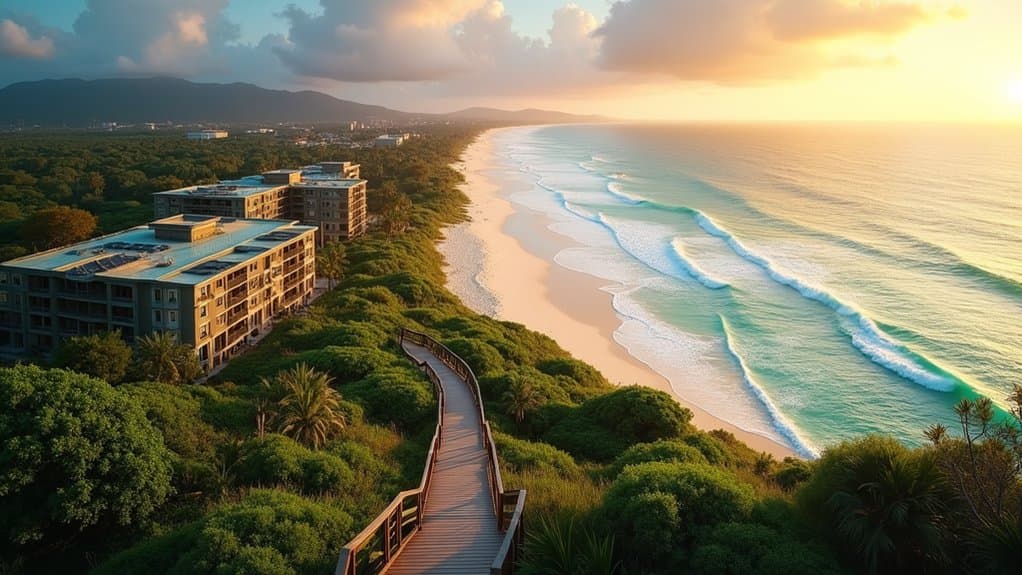
The first time you step onto the sand at Encuentro, the sound of the waves tends to drown out everything else. But look past the surf breaks and you'll find one of the most compelling financial stories in the Caribbean. I've been handling property transactions on the North Coast since 1986, and what I'm seeing now in Encuentro is different from the usual cycles. This isn't the polished resort zone of Punta Cana or the high-rise creep of Puerto Plata. It's a tight market where beachfront property for sale commands premium prices because there simply isn't much left to buy.
Last Tuesday, a client from Vancouver walked into my office with a printout from a listing site. Beautiful photos. "Beachfront villa, $450,000." I asked him if he'd verified the Deslinde. He looked at me like I'd asked if he'd checked for ghosts. Three days later, we discovered the property line on the old title was 40 meters off from where the actual fence stood. The "beachfront" lot was actually second-line, and the seller knew it. That's the difference between someone who understands investing in Cabarete and someone who's about to lose a deposit.
Encuentro Beach real estate isn't for everyone. If you want turnkey luxury with a concierge desk, look elsewhere. But if you're willing to navigate the realities—the unpaved roads, the occasional power hiccup, the fact that your lawyer needs to physically drive to the Puerto Plata Land Registry to verify your title—then you're looking at a market that delivered 6% appreciation in 2024 and shows no signs of cooling off.
Key Takeaways
Price Reality: True beachfront condos in Encuentro trade at $2,600-$3,200 USD per square meter, while second-line properties sit at $1,800-$2,200—a 30-40% discount that often narrows when second-line lots have elevated ocean views.
Legal Non-Negotiable: Never purchase without a completed Deslinde under Law 108-05. Roughly 30% of older "for sale by owner" listings still lack this GPS-verified boundary demarcation, creating boundary disputes that can take years to resolve.
Rental Yields: Gross yields of 8-12% are possible for beachfront units, but realistic net yields after management fees (20-25%), maintenance, and seasonal gaps typically land at 5-7%.
Infrastructure Truth: Starlink has solved the internet problem (RD$2,900/month, ~$50 USD), but grid power remains inconsistent. Solar systems now pay for themselves in 3.5-4 years given electricity rates in gated communities with private grids often exceeding $0.30/kWh in top tiers—though direct Edenorte grid connections typically run $0.18-$0.24/kWh depending on consumption blocks.
Zoning Constraints: Strict 60-meter setbacks from the high-tide line and 3-level height limits preserve the "jungle aesthetic" but also create scarcity that drives prices up faster than markets with unlimited expansion room.
The "Boots on the Ground" Perspective: Why Encuentro Beach is Different
I've sold properties in five residential developments in this area over the past 20 years—Encuentro Residences and Encuentro Surf Village among them. The demographic shift I'm seeing now is stark. Ten years ago, my typical buyer was 60+, looking for a retirement villa. Today, it's a 38-year-old German software engineer who wants to surf before his 9 AM Zoom call. The "Surf & Work" crowd has rewritten the demand equation.
This shows up in the numbers. Beachfront condos in Encuentro generate gross rental yields of 8-12%, outperforming the Caribbean average of 5-7%. High-season occupancy (December through April) hits 85-90%, driven by consistent surf conditions that align with North American winter. But here's what the listing sites won't tell you: low season (May-June, September-October) drops to 40-50% occupancy. Your annual average matters more than your peak month.
The entry price floor has hardened. Even older studios or "surf shacks" in the Encuentro area now start at $150,000-$180,000 USD. Prime beachfront land commands over $1,000 per square meter, while lots 400 meters back can still be found for $150-$400 per square meter. That gap represents the market's honest assessment of walkability to the break.
What makes Encuentro distinct from downtown Cabarete is the zoning. Unlike the high-rises creeping into Puerto Plata, Encuentro operates under strict low-density rules—typically 3 levels maximum for beachline properties. The Ministry of Tourism enforces a 60-meter setback from the high-tide line for any permanent construction. This isn't developer preference; it's Law 305-68, and it's non-negotiable. The result is a preserved "jungle-meet-ocean" aesthetic that can't be replicated once it's gone.
The surf economy here is real. Five active surf schools operate daily from 6:00 AM—Pauhana, Chino Surf School, and others. This creates a "dawn patrol" rental demand that outpaces standard tourist hours. Properties with board storage, outdoor showers, and early-morning light capture premium rates because they serve a specific use case that the market has validated.
But let's be clear about what this isn't. Encuentro is not polished. The main road (La Pista) is paved, but internal roads are largely hard-pack dirt and gravel. You need an SUV or crossover for comfortable daily driving. The community is most active between 6:00 AM and 10:00 AM, then again in the late afternoon. If you're expecting nightlife, you're in the wrong spot. Downtown Cabarete is five minutes away if that's what you want, but Encuentro enforces a "quiet zone" after 10 PM.
The buyer demographic shift from retirees to 35-50 year old professionals has been accelerated by the post-2020 remote work boom. These buyers aren't looking for all-inclusive resorts. They want reliable internet (Starlink solved that), walkable community spaces (the Encuentro Food Park provides that), and a lifestyle that blends fitness with productivity. That's a narrower target than generic "Caribbean real estate," but it's a target with money and conviction.
Safety First: The "No-Nonsense" Legal Framework
The single biggest mistake I see is buyers who confuse a "Constancia Anotada" with a valid title. Let me be direct: a Constancia Anotada is an old-format document that does not meet the requirements of Law 108-05. If someone tries to sell you property with only this document, walk away. Since the implementation of Law 108-05 (Registry of Real Estate), the Deslinde is mandatory. It uses GPS coordinates to define boundaries with state-guaranteed accuracy.
Here's what the Deslinde process actually involves. A licensed surveyor (Agrimensor) physically marks the property boundaries using GPS equipment. These coordinates are then registered at the Registro de Títulos. The result is a "Certificado de Título" that cannot be disputed by neighbors claiming historical fences or verbal agreements. Roughly 30% of older rural properties still lack a completed Deslinde, which is why I have a direct contact at the Puerto Plata Land Registry. We can verify title status in 3-5 business days and see any liens (hipotecas) or judicial blocks (litis sobre derechos registrados) before money changes hands.
The failure rate on "for sale by owner" properties in older areas is high. I've seen deals collapse in the final week because the seller couldn't produce a clean Deslinde. Sometimes the GPS survey reveals the property line is 20 meters different from where the seller thought it was. Sometimes there's an unresolved inheritance dispute from a deceased co-owner. These aren't edge cases—they're common enough that due diligence isn't optional.
Understanding CONFOTUR: The 15-Year Tax Exemption That Actually Matters
CONFOTUR (Law 158-01) is the most misunderstood incentive in Dominican real estate. Here's what it actually does: qualifying tourism developments receive a 15-year exemption on the 1% annual IPI (property tax) and the 3% transfer tax. For a $300,000 property, that's $9,000 saved on the initial purchase and $3,000 saved annually. Over 15 years, that's $54,000 in avoided taxes.
But not every project qualifies. The development must be classified as a "Tourism Project"—hotels, condo-hotels, or tourist-oriented residential complexes with rental pool services. Purely residential subdivisions don't qualify. The project must be in a declared "Tourist Pole" (Cabarete and Sosúa are designated zones), and the developer must submit a Technical-Architectural Project approved by the Ministry of Tourism's Department of Planning and Projects.
Here's the trap: some developers advertise CONFOTUR benefits before receiving final approval. A "Provisional Classification" is not the same as "Definitive Classification." Buyers should demand to see the actual "Resolución del Consejo de Fomento Turístico" document that specifically names the project. You can verify this independently by checking the official list of approved projects on the Ministry of Tourism website (mitur.gob.do).
For resale properties, the CONFOTUR benefit transfers to the new owner for the remaining years of the 15-year window. Your sales contract must explicitly state that the unit benefits from Law 158-01 exemptions. If that clause is missing, you may not be protected during tax filing. I've seen buyers lose this benefit because their lawyer didn't verify the exemption was properly noted on the title certificate.
Foreign Ownership Rights: What the Constitution Actually Says
Article 25 of the Dominican Constitution grants foreigners the exact same property ownership rights as citizens. You do not need a fideicomiso (trust structure) like in Mexico. You do not need a local partner. You can own property in your personal name, and that ownership is constitutionally protected.
The wrinkle is inheritance. Dominican law includes "forced heirship" (La Legítima), which reserves a portion of your estate for direct descendants regardless of what your will says. Foreign buyers can mitigate this by holding property in a Dominican Company (SRL) or through specific will structures. We work with immigration lawyers in Santo Domingo who've handled this for sports professionals and investors getting their residencies and citizenships. The solution exists, but it requires planning before you buy, not after.
One practical benefit: buying property valued at $200,000 USD or more qualifies you for Fast-Track Residency (Investment Residency). This bypasses the standard temporary residency timeline. Turkey raised its Citizenship by Investment minimum to $400,000 USD in June 2022, and Portugal removed real estate investment as a qualifying path for its Golden Visa in October 2023. The Dominican Republic's $200,000 threshold is now half the price of Turkey's program and more straightforward than most European alternatives.
Market Inventory Analysis: What You Can Actually Buy
Let's talk about what inventory actually exists. "First Line" beachfront inventory is less than 5% of total listings in Encuentro. True beachfront means direct ocean frontage with no road between you and the sand. These properties are strictly zoned—60 meters from the high-tide line for any permanent construction, maximum 3 levels, and green space requirements that dictate you can't cover more than 60% of the lot with impermeable surfaces.
Beachfront villas in Cabarete generally start at $800,000 USD and can exceed $2 million. Comparable second-line villas in gated communities like Pro Cab or near Encuentro range from $350,000-$600,000 USD. That price gap reflects not just ocean frontage but also maintenance costs. Salt air corrosion is aggressive. Electronics and appliances have a 30% shorter lifespan within 200 meters of the ocean unless they're marine-grade. Your air conditioning units will need replacing more frequently. Your metal fixtures will corrode faster. This isn't a minor detail—it's a line item in your annual budget.
Second-line properties often sit on elevated ridges, which means some still command premium ocean views comparable to beachfront. In those specific topographic cases, the price gap narrows to around 15%. Properties priced under $300,000 in Encuentro have an average days-on-market of 45-60 days, significantly faster than the luxury sector ($1M+), which sits for 180+ days. Resale liquidity matters if you're treating this as an investment rather than a forever home.
The Rise of Eco-Living: Solar, Septic, and Sustainability
High-quality construction costs in Cabarete have risen to $1,200-$1,500 USD per square meter for a turnkey villa. That's global material inflation showing up in your build budget. But the ROI on sustainability features has improved dramatically. With grid electricity rates in gated communities with private grids often exceeding $0.30/kWh—though direct Edenorte connections typically run $0.18-$0.24/kWh depending on consumption blocks—a hybrid solar system (approximately $15,000 investment) has a break-even period of just 3.5-4 years.
Most eco-homes in Encuentro utilize septic tanks and soakaways—there is no municipal sewage line. "Bio-digestors" are the new standard for eco-compliance. These systems break down waste more efficiently than traditional septic and meet environmental regulations. If you're buying land for sale in Cabarete with the intention to build, budget for water systems upfront. Trucked water (camión de agua) costs approximately RD$1,500-RD$2,000 for 2,500 gallons if your cistern runs dry or well water is too saline.
HOA fees in Encuentro gated communities typically range from $2.50-$3.50 per square meter per month, covering security, backup power, and common water. That's $150-$210 monthly for a 60-square-meter condo. Many new developments are pre-wiring for "redundant internet"—installing dual lines (Starlink + fiber) as a standard amenity to guarantee 100% uptime for remote workers. That's not a luxury feature anymore; it's a competitive necessity.
Buying off-plan in the DR typically offers a 15-20% discount compared to turnkey delivery prices, but it carries timeline risks. I've seen projects delayed by six months due to permit processing. If your financial model depends on rental income starting by a specific date, pre-construction might not be the right path.
Infrastructure & Living: The Realities Behind the Postcard
Starlink Residential service is fully available in Cabarete for RD$2,900/month (approximately $50 USD), delivering stable speeds of 100-200 Mbps. This solved the "digital nomad" reliability issue that plagued the area for years. Fiber optic internet is also available through Claro and Altice, offering plans up to 100-300 Mbps for $40-$60 USD/month. Latency for Starlink averages 40-60ms, sufficient for Zoom calls and online gaming. Fiber connections often achieve 10-20ms.
The hardware cost for Starlink is approximately RD$20,000-RD$25,000 (~$350-$450 USD) upfront. But here's the advantage during power outages: Starlink can be powered by a simple portable battery station (EcoFlow or Jackery). Fiber modems require the street-level node to also have power, which isn't always backed up. Reliability during outages matters when you're on a client call.
Edenorte is the local power provider. The grid is stable 90% of the time, but the "last mile" infrastructure in Encuentro can be fragile. Inverters and batteries are mandatory, not optional. In non-gated areas, "hook-ups" to private lines occur—electricity theft is a real issue. Gated communities prevent this, preserving the integrity of your bill. 5G mobile data coverage from Altice and Claro is available in the Encuentro area, serving as a reliable backup layer.
The nearest modern medical facility, Centro Médico Cabarete (CMC), is 5-10 minutes away and accepts major international insurance (IMG, VUMI). Puerto Plata Airport (POP) is only 20 minutes away, with daily flights from Miami (MIA) and New York (JFK/EWR). Flight time from Miami to Puerto Plata is 1 hour 50 minutes—compare that to 9+ hours for Europe or 14+ hours for Dubai.
Local "Guaguas" (minibuses) cost RD$50-100 to get to Sosúa or Kite Beach. "Motoconchos" (motorcycle taxis) cost RD$100-200 for short hops. Propane (GLP) for cooking costs approximately RD$130 per gallon (subsidized rate), making it affordable for residents. The Encuentro Food Park and local markets have created a walkable social hub, reducing the need to drive into downtown Cabarete for dining.
Real-World Lessons: What I've Seen Go Wrong (and Right)
A few months ago, a client from Munich contacted me about a "bargain" lot near the river mouth. The price was suspiciously low—$80 per square meter when comparable lots were trading at $200-$300. The seller had a Carta Constancia but no Deslinde. We ordered a survey. Turns out the GPS coordinates didn't match the physical location by more than 50 meters. The "beachfront" lot was actually set back behind a neighbor's property, with no legal access to the water. The seller knew this. The client would have lost his deposit if we hadn't caught it.
Another case: a Toronto buyer nearly purchased a condo without realizing the HOA bylaws banned short-term rentals. The listing advertised "investment opportunity" and "rental income potential." Clause 17.3 of the bylaws had been amended in 2022 to restrict Airbnb-style rentals to protect long-term residents. Without checking the bylaws, his rental projections would have failed immediately. We caught it during due diligence. He walked away and found a different unit in a rental-friendly building.
On the success side: a client from California maximized ROI on a 2-bedroom condo by targeting the "Surf & Work" niche. He installed board racks, ergonomic office chairs, and upgraded to fiber optic internet. His listing emphasized early-morning light for surfers and dedicated workspace for remote professionals. Result: 7% net yield by bridging the gap between high-season surf tourism and low-season long-term rentals (6+ months). Long-term rentals yield 5-6% net, while short-term (Airbnb) can hit 8-10% net, but with significantly higher wear-and-tear and management effort. He found the middle path.
Adding a "casita" or studio to a villa lot can cost $35,000-$50,000 but adds $800-$1,200/month in rental revenue—a 25%+ cash-on-cash return. Properties with proven rental history (Airbnb Superhost status plus two years of ledgers) sell for a 10-15% premium over empty homes. The market rewards documentation.
Property management companies charge 20-25% of gross rental income for full-service Airbnb management (marketing, cleaning, check-in). That's not optional if you're not living on-site. Factor it into your yield calculations from day one, not after you've already committed to a purchase price.
The Investor's Decision Matrix: DR vs. The World
| Criteria | Dominican Republic (Encuentro) | Dubai (UAE) | Portugal | Turkey |
|---|---|---|---|---|
| Minimum Investment for Residency | $200,000 USD | ~$270,000 USD | N/A (Golden Visa removed real estate path in Oct 2023) | $400,000 USD (since June 2022) |
| Transfer Tax | 3% (0% with CONFOTUR) | 4% (DLD Fee) | 6-8% (IMT + Stamp Duty) | ~4% |
| Annual Property Tax | 1% (on value exceeding ~$170k; 0% with CONFOTUR for 15 years) | 0% | 0.3-0.8% (IMI) | Varies by municipality |
| Currency Risk | None (USD transactions) | Low (AED pegged to USD) | Moderate (EUR fluctuation) | High (Lira inflation) |
| Flight Time from Miami | 1h 50min | ~14 hours | ~9 hours | ~12 hours |
| Typical Rental Yield | 5-7% net (beachfront) | 4-6% net | 3-5% net | 6-8% net (high volatility) |
| Best For | Active lifestyle investors, surf/eco focus, USD hedge | Luxury seekers, tax optimization | EU access (residency path closed) | Citizenship seekers (high risk) |
Portugal removed real estate investment as a qualifying path for its Golden Visa in October 2023, eliminating the DR's main European competitor for lifestyle property visas. Turkey raised its Citizenship by Investment minimum to $400,000 USD in June 2022, making the DR's $200,000 residency threshold half the price. Dubai charges a 4% Transfer Fee (DLD) on all property transactions—higher than the DR's 3% Transfer Tax, which drops to 0% if the property has CONFOTUR certification.
The DR has no double-taxation treaty with the USA, meaning US citizens must report global income but can utilize the Foreign Tax Credit. Local banks (Scotiabank, Banreservas) offer mortgages to foreigners, but LTV is usually capped at 50-60% with interest rates often 8-10%. Cash purchases dominate the market.
The Dominican Republic welcomed over 10 million visitors in 2023/2024, ensuring a steady stream of fresh eyes on the real estate market. Proximity matters. Flight time from Miami to Puerto Plata is under two hours. Compare that to 9+ hours for Europe or 14+ hours for Dubai or Bali. If you need to visit your property twice a year for maintenance or tenant issues, that time difference compounds.
Step-by-Step Buying Guide: From Search to Title
1. Define Your "Must-Haves" Before You Look
Surf access versus privacy. Rental income versus personal use. Gated security versus open community. These aren't preferences—they're filters that eliminate 70% of listings before you waste time on site visits. If you need consistent rental income, you cannot buy in a building that bans short-term rentals. If you need quiet for remote work, you cannot buy next to a surf school that starts lessons at 6:00 AM.
2. Assemble Your Team (Lawyer First, Agent Second)
Never sign an offer before hiring an independent lawyer. Not the developer's lawyer. Not the agent's recommended lawyer. Your lawyer. We've been practicing since 1986, and we've seen every variation of title fraud, boundary dispute, and inheritance ambush. A $5,000-$10,000 USD reservation deposit is standard to take a property off the market, but it should always be held in the escrow account of the agency or lawyer—never given directly to the seller.
3. The Verification Process (What We Actually Check)
We request the Title Certificate Number and verify Deslinde status at the Puerto Plata Land Registry. This takes 3-5 business days and reveals liens (hipotecas) and judicial blocks (litis sobre derechos registrados). We confirm whether the project has an active CONFOTUR resolution if tax exemptions are advertised. We review bylaws if rental income is part of your strategy. We confirm USD versus DOP payment terms in the contract.
If the property is in a company name, we perform a corporate search at the Chamber of Commerce to verify the seller's corporate status and authority to sell. We check that the seller is current on IPI (annual property tax) payments—this is mandatory for closing.
4. The Promise of Sale (Promesa de Compraventa)
This is the binding contract signed after due diligence. It legally locks the price and terms. Total closing costs are roughly 5% of the purchase price (3% Transfer Tax + 1% Notary/Legal + 1% Miscellaneous expenses). The 3% Transfer Tax must be paid within six months of signing the contract to avoid penalties.
5. Closing Without Being Present
You do not need to be in the DR to close. A specific Power of Attorney (Poder Consular) can be signed at the nearest Dominican Consulate in your home country. Under Law 155-17 (Anti-Money Laundering), the DGII restricts cash transactions for real estate above RD$1,500,000 (approximately $25,000 USD at 2026 exchange rates). All real estate payments above this threshold must be made via wire transfer or check to comply.
6. Title Transfer Timeline
Receiving the new physical "Certificado de Título" in your name typically takes 2-4 months after the sale is registered. You must register with the DGII (Internal Revenue) to obtain an RNC (Tax ID) for property tax purposes. This is non-negotiable.
Is Encuentro Right for You?
Encuentro is not for everyone. If you need predictable timelines, this is not the right market—municipal approvals often take longer than buyers from the U.S. or Canada expect. If you want a turnkey, Miami-style condo experience with 24-hour front desk service, look elsewhere. If you're uncomfortable with unpaved roads, occasional power outages, or the reality that your air conditioner will need replacing more frequently due to salt air, this will frustrate you.
But if you seek a community-driven, nature-first lifestyle with solid appreciation potential in a USD market, Encuentro offers something rare. The International School of Sosua (ISS) and Isla Academy offer US-accredited curriculums for $6,000-$8,000/year, making family relocation viable. Cabarete is considered one of the safest towns in the DR for expats, with a dedicated POLITUR (Tourist Police) presence. The expat density means English is spoken in 90% of commercial interactions.
The beach culture is highly dog-friendly, with loose leash laws compared to US or European restrictions. Beyond surf, Encuentro has a high density of yoga studios, Jiu-Jitsu gyms, and CrossFit boxes, catering to the "active lifestyle" investor. This isn't a retirement community anymore—it's a place where people in their 30s and 40s are building businesses, raising kids, and staying fit while the surf break is 200 meters from their door.
The scarcity factor is real. Cabarete has a limited coastline zoned for high-density tourism. Unlike Punta Cana, which has miles of flat expansion room, Cabarete is constrained by the main road and lagoon. That constraint forces prices up as inventory shrinks. Over a 5-year period (2020-2025), beachfront property values in prime Cabarete areas have increased by approximately 30-40% cumulatively. Specific high-demand niches like Encuentro have seen 10-15% annually.
If you approach the market with patience and proper verification, it can be both financially sound and personally rewarding. Every property on the North Coast tells a different legal story. Make sure yours is one you can live with.
For a consultation to review specific Encuentro Beach real estate listings and verify their legal standing, contact our office. We've been handling these transactions since before most of the current inventory was built. We know which developers deliver on time, which title searches reveal problems, and which properties actually qualify for the tax benefits they advertise.
Disclaimer: This content is for educational purposes and does not constitute financial or legal advice. Always consult with a qualified attorney for real estate transactions in the Dominican Republic.